AI Search Visibility Guide for life science marketers

AI search visibility for science marketers

Click to interact with and expand each step below

What do AI tools tell your buyers about you?

Increasingly, your buyers are aksing ChatGPT, Perplexity, Claude and Google’s AI Overviews about suppliers and technologies before visiting company websites. These answers can influence which suppliers make the shortlist.

In TrustRadius’s 2026 survey of 1,862 technology buyers, 63% used AI during a purchase, and 94% of those checked its answers at least some of the time [7]. Being visible matters. Being described accurately matters as much.

This guide sets out 14 steps in three layers to help make your site readable to AI, build the third-party evidence AI draws on, and measure what’s working. Before you start working through them in order, capture your baseline. 

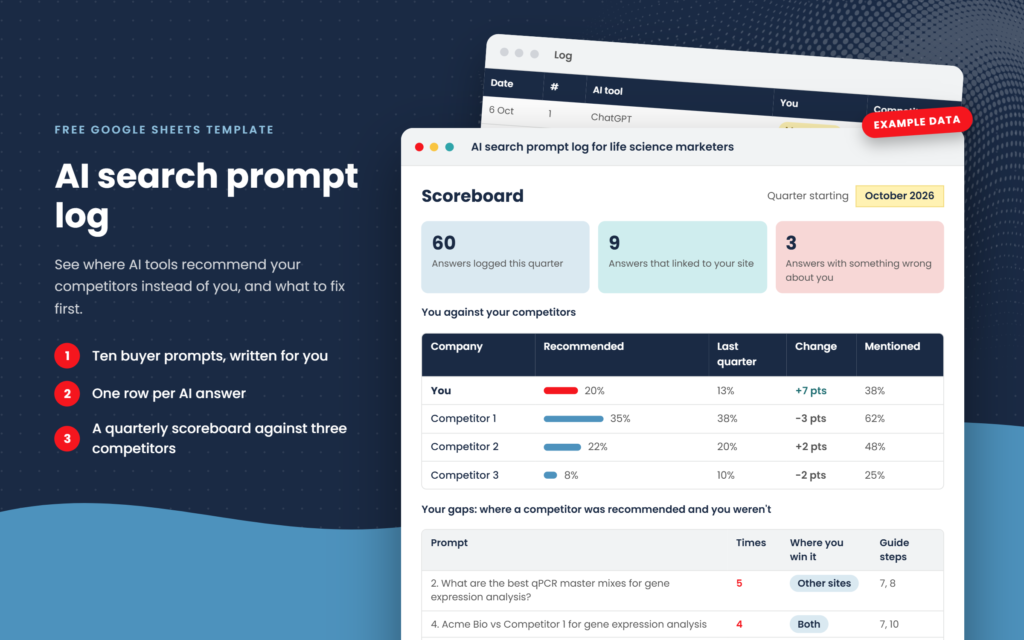
Our free template suggests ten buyer prompts to start with. Log each AI answer as one row, and the quarterly scoreboard shows where AI recommends competitors instead of you and which steps fix it.

In this guide:

  • LAYER 1 | FOUNDATION: Six steps to make your site readable to AI search tools.
  • LAYER 2 | AMPLIFICATION: Five steps to build the third-party evidence AI uses to shortlist suppliers.
  • LAYER 3 | MEASUREMENT: Three steps to track mentions, accuracy and pipeline from AI search.
  • FREE TEMPLATE: A prompt log and quarterly scoreboard to copy into Google Sheets.

    Copy the template →
Layer 1 FOUNDATION

First, ensure that your content is findable and extractable by AI. AI search tools need to crawl your site, read your content cleanly and understand what your company does. One line in robots.txt or one firewall setting is enough to keep AI search tools out. Work through steps 1-6 below to make sure you catch any technical issues that could prevent AI crawlers from doing their job.


Step 1
Unblock AI crawlers
Check that AI search tools can reach your site.
Do this first. Everything else depends on it.
  • 1Open yourdomain.com/robots.txt and look for Disallow rules.
  • 2Allow the search crawlers. These decide whether you appear in AI answers: OAI-SearchBot (ChatGPT search), PerplexityBot, Claude-SearchBot and Googlebot (Google AI Overviews and AI Mode use the normal Google index).
  • 3Decide on the training crawlers separately. Blocking GPTBot or ClaudeBot opts you out of model training without removing you from ChatGPT or Claude search. Google-Extended has no effect on Google Search or AI Overviews.
  • 4Ask your web team to check the firewall and CDN bot settings (Cloudflare and similar). These can block AI crawlers regardless of what robots.txt says.
  • 5Check key pages for a noindex tag. A noindexed page drops out of Google’s index, and out of AI Overviews with it.

Time: About 30 minutes to check. Longer if the web team needs to change firewall or CDN settings.

Owner: Marketing checks, the web team fixes.

Done when: robots.txt allows the relevant search crawlers, firewall bot settings are checked and key pages carry no noindex tag.

Step 2
Structure content for extraction
AI tools often quote single passages. Build your pages for that.
Scannable is good. Extractable is better.
  • 1Give every section a clear H2 or H3 heading that describes exactly what that section answers.
  • 2Open each section with a short, direct answer to the question in its heading, then explain.
  • 3Use tables for technical and product comparisons, numbered lists for processes, and bullets for features. Do not bury information in long paragraphs.
  • 4Make each section make sense on its own. AI tools often quote one passage without the text around it.

Time: 1 to 2 hours per page.

Owner: Marketing, with product managers for technical pages.

Done when: Your 5 to 10 most important pages open each section with a direct answer under a descriptive heading.

Step 3
Add schema markup
Label your pages so search engines know what they describe.
Schema helps search engines read your pages. No well-documented study shows schema alone increases AI citations, so treat schema as housekeeping.
  • 1Add Organization schema to your homepage, with your name, logo, description and sameAs links to your LinkedIn, Crunchbase and directory profiles.
  • 2Add Article schema to blog posts and thought leadership, with author, publish date and modified date.
  • 3Add Product schema to relevant product pages, with the product name, description and applicable technical details that are also visible on the page.
  • 4FAQPage markup isn't necessary for Google Search which stopped showing FAQ results in May 2026 and HowTo rich results were discontinued in 2023. Don’t expect either to improve your AI search visibility.

Time: Half a day, or longer if your CMS needs a developer.

Owner: The web team.

Done when: Organization, Article and Product schema pass the Schema Markup Validator (validator.schema.org).

Step 4
Include quotable data
Statistics and named sources are often easier for AI systems to extract and reference.
In the GEO study (Aggarwal et al., KDD 2024), adding statistics and quotations made content more visible in AI answers. The test used a simulated engine built on GPT-3.5, so trust the direction more than the exact numbers.
  • 1Include specific numbers: sensitivity, throughput, timelines, percentages, and outcomes. Specific well-supported claims are easier to verify and cite than vague ones.
  • 2Name your sources inline, with the year: “According to [publication], [year]”.
  • 3Publish ungated HTML summaries of your application notes, validation data and posters, with the method and key results in text. Keep the full PDF gated if lead capture matters.
  • 4Put key statistics in tables or callout boxes. These are easier for AI to extract than data buried mid-paragraph.

Time: 1 to 2 hours per page. Allow longer for ungated summaries of application notes.

Owner: Marketing, with application scientists.

Done when: Key pages state their main numbers in text with a named source and releveant qualifications, and your three most important gated assets each have an ungated HTML summary.

Step 5
Keep content accurate and current
Regularly review key pages to ensure information remains accurate, relevant, and up to date.
Current, accurate information is more useful to both buyers and AI systems than outdated content.
  • 1Audit your top 10 most-visited pages and note the last updated date on each.

  • 2Review important commercial pages quarterly and update any outdated statistics, references, or product information.

  • 3Update the modified date in your schema markup when content has genuinely been refreshed.
  • 4Prioritise pages that answer questions your buyers are actively researching.

Time: Half a day for the first audit, then 1 to 2 hours a quarter.

Owner: Marketing.

Done when: Your top 10 pages each show a last-updated date and have a named owner, and a quarterly review is in the calendar.

Step 6
Write plainly and directly
AI tools read literally. Ambiguous sentences are harder to quote.
The sentence you want cited must be self-contained.
  • 1Write your key claims as standalone sentences that make sense without the surrounding context.
  • 2Avoid metaphor in the sentences you most want cited. Save nuance for the explanation that follows.
  • 3Lead with the answer, then explain. A clear opening sentence makes the key information easier for readers and AI tools to identify.
  • 4Read each key paragraph aloud. If it could mean two things, rewrite it until it means one.

Time: About 30 minutes per page, alongside Step 2.

Owner: Marketing.

Done when: Each key claim on your top pages reads correctly as a standalone sentence.


Layer 2 AMPLIFICATION

Your own pages get you cited, but what others say about you helps to get you shortlisted in AI chat results. Build the third-party evidence AI tools use when they recommend suppliers; information is drawn from review sites, publications, directories and distributor pages. Steps 7-10 cover what you need to do to increase the chances of your brand being cited.


Step 7
Get onto sector review and comparison sites
Independent reviews and comparisons can provide additional evidence of your credibility, helping AI tools and potential buyers evaluate your offering.
Several independent sources saying the same thing about you makes you easier to recommend.
  • 1Ask ChatGPT and Perplexity “best [product category] for [application]” and note which sites they cite. Those are your targets.
  • 2Get listed and reviewed on life science product sites such as SelectScience, Biocompare and Labcompare, where they cover your category.
  • 3Encourage customers to share their experience through publications, posters, presentations and case studies where appropriate. Independent scientific evidence that names your product can strengthen your credibility.
  • 4When you get listed, make sure your description is accurate and specific. This is what AI repeats when it describes you.

Time: 2 to 3 hours to build the target list, then ongoing.

Owner: Marketing, with product management.

Done when: You have a list of the sites AI tools cite for your category, and accurate listings on the ones relevant to you.

Step 8
Build your directory presence
Consistent entries across high-authority directories build entity confidence in AI systems.
Consistent information across authoritative sources helps reinforce entity recognition and brand understanding.
  • 1High authority first: LinkedIn Company Page, Crunchbase and Companies House.
  • 2Sector-specific: Trade association member listings (for example BIVDA or ABHI in the UK), trade show exhibitor pages and specialist directories in your niche.
  • 3Check every distributor and reseller page for your products. These often carry old descriptions, discontinued products or wrong regulatory status, which AI-generated answers could repeat.
  • 4Always use a consistent, accurate description of your company, adapting it where necessary for each platform, and update your listings when your offering changes.

Time: About a day for the first pass. Distributor fixes take longer because other people own those pages.

Owner: Marketing, with your channel or distributor manager.

Done when: Your company descriptions are consistent and accurate across relevant listings, and distributor errors are logged and sent for correction.

Step 9
Earn press and media mentions
PR and editorial coverage give AI tools independent sources to draw on.
Independent editorial mentions help reinforce brand authority and increase the number of sources that can reference your expertise.
  • 1Target life science trade press. Expert quotes and contributed pieces in sector publications create authoritative third-party references that AI systems can discover and cite.
  • 2Offer expert comment to journalists covering your application areas and technologies. Each mention adds an independent source.
  • 3Publish data-led pieces you own: reports, surveys, original analysis. These get cited by other publications, which then get cited by AI.
  • 4Track new mentions with Google Alerts for your brand name, and check each one for accuracy.

Time: A few hours a month, ongoing.

Owner: Marketing or PR.

Done when: You have a target list of trade titles and journalists, and a Google Alert runs for your brand.

Step 10
Control your brand narrative
AI describes your brand. You need to make sure it describes it correctly.
Search your brand in ChatGPT right now. Is the answer right?
  • 1Ask ChatGPT, Perplexity, Gemini and Google AI Mode “What does [company] do?” and “What is the regulatory status of [product]?” Run each prompt three times and read the answers carefully.
  • 2Send any error about regulatory status, intended use or performance claims to your regulatory or QA team before you change the copy. An RUO product described as diagnostic is a compliance risk as well as a marketing one.
  • 3If the description is wrong, missing, or vague, review your About page, your Organization schema, and relevant directory entries inaccuracies or missing information. Also check the sources the AI tools are citing.
  • 4Write a definitive “what we do” paragraph on your website using the exact language you want AI to repeat. Keep it plain and specific.
  • 5Make sure your LinkedIn Company Page description is consistent with your website. LinkedIn is one of several key sources that AI tools use to understand and describe companies.

Time: 1 to 2 hours to run the prompts. Fixes vary.

Owner: Marketing, with regulatory or QA for any regulatory error.

Done when: Errors are logged in your prompt log, regulatory errors are with RA or QA, and your company descriptions are consistent across your website and LinkedIn.

Log errors in the free prompt log →

Step 11
Show up beyond your website
AI tools build recommendations from many different sources, not just your website.
Every platform where your expertise is documented counts.
  • 1LinkedIn: publish thought leadership articles, not just posts. Long-form content creates additional authoritative references for your expertise.
  • 2Reddit and niche forums: if your team participates in relevant communities, those discussions create additional publicly available evidence of expertise. Post under your own name and say who you work for.
  • 3YouTube: if you produce video content, publish a transcript or summary page on your website alongside it.
  • 4Podcast appearances, guest articles, webinar recordings, conference posters and abstracts can all help establish your expertise. Make these accessible online wherever possible, with clear attribution to your company and experts.

Time: Ongoing.

Owner: Marketing, with your subject-matter experts.

Done when: Every video has a transcript or summary page, and your experts publish under their own names on platforms your buyers use.


Layer 3 MEASUREMENT

Rankings, traffic and click-through rate don’t show whether AI tools name you, cite you or describe you accurately, so you need a separate set of measures. Track what is working and review every quarter. AI referral traffic also behaves differently from organic search, so measure it separately rather than assuming it converts better. Use our free template to help you set this up.


Step 12
Track your AI citations
Find out how often AI is mentioning and citing your brand.
Start with a simple prompt log before you pay for a tool.
  • 1Make a copy of the free prompt log below and fill in your company, competitors and product. It writes ten buyer prompts for you, from “how can my lab get more reliable [application] results?” to “[you] vs [competitor]”. Once a month, test each prompt in ChatGPT, Perplexity, Claude (and any other tools your buyers use while logged out), and log whether your brand appears. Over a quarter, that gives you three runs of every prompt in each AI tool.
  • 2In GA4, create a custom channel group for AI referrals, including: chatgpt.com, perplexity.ai, gemini.google.com, copilot.microsoft.com and claude.ai and any addititonal domains relevant to your category. Expect it to undercount, because many buyers read the answer and search for you later.
  • 3For larger prompt sets, tools such as Semrush’s AI Visibility Toolkit automate tracking. Their data comes from their own prompt samples, so compare like with like.
  • 4Track citation rate (does your URL appear?) and mention rate (is your brand named?) separately. Report both as rates, for example “named in 4 of 10 runs”.

Time: About 2 hours to set up, then about 20 minutes a month to log answers.

Owner: Marketing.

Done when: Your prompt log holds a baseline round and the GA4 AI channel group is live.

Copy the free prompt log →

Step 13
Benchmark against competitors
Find out who AI recommends instead of you, and why.
Strong Google visibility does not automatically translate into strong AI visibility.
  • 1Ask ChatGPT “What are the best [product category] suppliers for [application]?” and note every brand mentioned.
  • 2For each competitor that appears, review their content structure, schema, and directory presence. Look for differences that may help explain their visibility and identify opportunities to improve your own content.
  • 3Track share of voice: across your ten prompts, what percentage of runs name you versus each competitor?
  • 4Repeat monthly with the same prompts, and compare quarter with quarter. Monthly numbers move a lot by chance.

Time: About an hour a month on top of Step 12, using the same prompt log.

Owner: Marketing.

Done when: You have share of voice for you and your top three competitors for the same quarter.

Copy the free prompt log →

Step 14
Measure the right outcomes
Clicks alone don't tell the full story. Here are additional the metrics that matter.
Early studies suggest AI referral traffic may convert at higher rates than traditional organic traffic, although performance varies by industry and website.
  • 1Branded search: track impressions for your brand name in Google Search Console week on week. Many buyers who see you in an AI answer search for you directly instead of clicking.
  • 2AI referral conversion rate: in GA4, compare how visitors from AI platforms convert versus standard organic. Measure the difference rather than assuming one exists.
  • 3Track cited pages separately. Pages that appear in AI-generated experiences may behave differently from the rest of your content and should be monitored independently.
  • 4Pipeline attribution: add a free-text “Where did you hear about us?” field to enquiry forms. Expect some answers like “ChatGPT recommended you”.
  • 5Follow AI-referred leads through to qualified opportunities and closed deals. Life Science purchasing cycles are often long, so measure lead quality, pipeline contribution and how effectively your team nurtures prospects through to purchase.

Time: About an hour to set up the form field, then a monthly review.

Owner: Marketing, with sales for pipeline tracking.

Done when: The free-text source field is live on enquiry forms and AI-referred leads are tagged in your CRM.

Key takeaways

  • AI search tools need to reach your pages before anything else matters. Check search crawlers, firewall settings and noindex tags first.
  • Your own content helps establish your expertise. Independent sources provide additional evidence that can support AI citations and supplier recommendations.
  • In Life Science, accuracy matters as much as visibility. Check what AI tools say about your regulatory status and intended use.
  • Put key data in text, not in gated PDFs or images.
  • Measure mentions, citations and accuracy as rates over repeated runs, and track AI-referred leads through to pipeline.

One honest caveat

AI search is hard to measure, and most AI platforms don’t publish query volumes, explain how they choose sources or show why one source appears in a given answer. Answers also vary from one run to the next, so a single check isn’t enough.

This means measurement is largely observational, so we need to look for several signals moving together over time.  Record a baseline at the start, then track mention and citation rates across repeated runs, branded search impressions, AI referral traffic, and enquiries that name an AI tool as the source. Use this free template to help you implement the steps in this guide and track results and improvement over time. 

This guide draws on published GEO research, documentation from Google, OpenAI and Anthropic, and practitioner experience.  Crawler rules and platform behaviour have changed several times since 2024, so treat these steps as current good practice and recheck platform documentation every few months.

Want to improve your AI search visibility?

AI answers change with every run, so one check tells you very little. Our free prompt log template gives you ready-made buyer prompts, a simple log and a quarterly scoreboard against your top three competitors.

Copy the free template
References

1. Princeton University; Georgia Tech; Allen Institute for AI; IIT Delhi (2024)
Generative Engine Optimisation (GEO): Improving Visibility in Generative Search Engines. Primary research examining interventions that increased citation frequency within AI-generated responses.

2. Schema.org
Structured data vocabulary and implementation guidance. Referenced in relation to schema markup and entity definition best practices.

3. Google Search Central
Documentation covering structured data, robots.txt directives, crawling, indexing, and content accessibility best practices.

4. OpenAI
GPTBot documentation and crawler guidance.

5. Anthropic
ClaudeBot crawler documentation and content access guidance.

6. Perplexity
PerplexityBot crawler documentation and publisher guidance.

7. TrustRadius (2026) 2026 B2B Buying Disconnect Report.

8. Loganix (2026)
B2B AI Buying Behaviour Analysis synthesising multiple independently published studies on AI usage during purchasing research.

9. Gauge & norg.ai (2025–2026)
Industry analyses examining Answer Engine Optimisation (AEO), Generative Engine Optimisation (GEO), citation behaviour, and AI visibility trends.

Looking to solve your marketing challenges? Let’s talk.

Have you seen our blog?

Qincade- Life Sciences & Biotech Marketing Agency | Cambridge & St Andrews

Hi! Let us know how we can help and we’ll respond shortly.

This site is protected by reCAPTCHA and the Google Privacy Policy and Terms of Service apply.

Get In Touch

auto popup img

Instant access to articles, tools & templates

Sign up to our list and be first to receive newly-published Qincade resources for science marketers.