
In this article
- Why high engagement can still produce a misleading lead score
- What can your CRM tell you about buying readiness
- Why scoring individual activity misses important account-level patterns
- How to distinguish fit, engagement, readiness, and timing in your interpretations
- What can modern scoring tools do with external signals and score decay
Lead scoring should help your revenue team decide where to focus. But in practice, many Life Ssciences marketers inherit a model they didn’t build, based on assumptions nobody can quite explain, that has been accumulating points in the CRM for years.
It’s hardly surprising that many teams become sceptical about whether lead scoring is useful at all. Often, they have good reason to be.
But if sales complains about lead quality, conversion rates are poor, or your pipeline contains a suspicious number of supposedly “hot” leads that never go anywhere, the answer may not be to abandon scoring altogether. Your model deserves a second look.
But before you start changing point values, there is a more important question to ask:
Is your lead-scoring model measuring the things that indicate a scientific buyer is moving towards a purchase?
For many Life Sciences marketers, the answer is: “only partially”.
Most CRM and marketing automation platforms are good at scoring what they can easily observe. Who someone is, where they work, whether they filled in a form, clicked an email link, attended a webinar or visited a particular page.
Those are useful data points, but they don’t tell you whether somebody has budget, whether an evaluation (with your product in it) is underway, whether several people at the account/same organisation are involved, or how soon a purchase is likely to happen.
So before asking whether a webinar deserves 10 points or 15, it’s a good idea to establish what your technology can observe, what you are inferring from that evidence, and whether those inferences stand up against what happens in the pipeline downstream.
When lead scoring goes horribly wrong
To some, this will sound very familiar…
Three years ago, someone on your team, or an agency, designed a lead scoring model that rewarded white paper downloads and webinar registrations with top marks. The logic seemed reasonable, and so the model was largely left alone to do its thing.
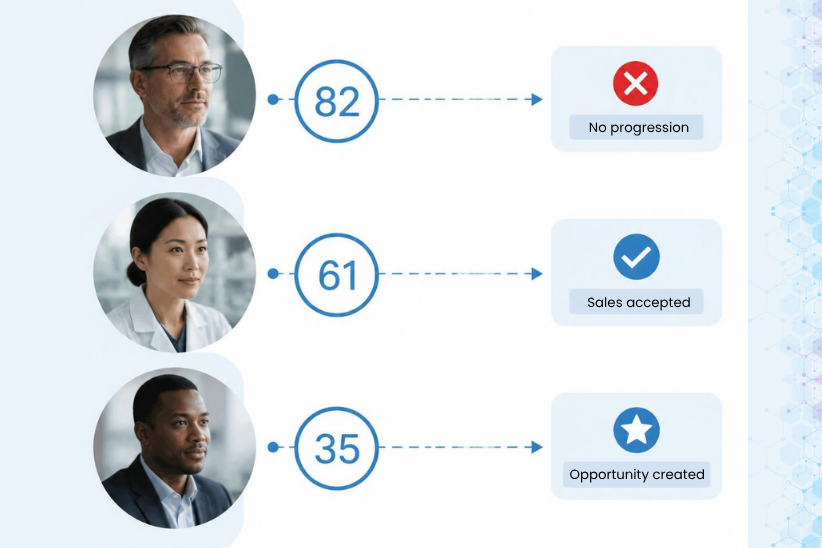
Today, some of your highest-scoring leads are undergraduate researchers downloading literature for their thesis. Meanwhile, a Head of Translational Research from a target account has visited two highly specific application pages but still has a low lead score because they haven’t attended webinars, clicked five emails or downloaded three gated assets.
One person has accumulated activity, and the other may be evaluating a purchase.
Your CRM can see all of these behaviours, but it can only interpret their relative importance through the rules you give it.
The issue is that when the scoring model overvalues activity, sales spends time on people with a tiny buying potential (the ‘not ready/right fit’ folk), whilst genuinely valuable prospects can remain below the handover threshold. Marketing continues to optimise towards behaviours with little relationship to revenue or at least stop short of adding layers designed for the less active engagers but better qualified to make buying decisions.
The model may be serving more certainty than the underlying evidence deserves.
What does a lead score actually tell us?
A conventional lead score does not know that someone intends to buy, nor that a buying committee has formed, that a researcher secured the grant making a purchase possible, or that somebody reading validation documentation is doing so because their organisation has shortlisted your technology. These situations happen outside of our view and are largely invisible to your CRM..
Your CRM only knows the data available to it, and your scoring model applies the rules you’ve created. Most teams using a mainstream tech stack can reasonably organise scores across three categories of evidence:
- Who the contacts are: Role, organisation, geography, company type, industry and other known demographic or firmographic characteristics.
- What the contacts do across channels you can track: Form submissions, website behaviour, email clicks, event participation, content engagement and sales activity, depending on your integrations.
- What the contacts explicitly tell you: Application area, project timing, purchasing plans, areas of interest and other information collected through forms and conversations.
Modern CRMs can already go further. For example, in HubSpot you can score companies using activity from their associated contacts, so engagement from multiple people within the same account (company) can contribute to a company-level view. It can also apply different decay rules to scored activities. Specialist platforms such as 6sense go further again, combining CRM and website activity with third-party intent data to model activity and buying stages at the account level. Technology can surface richer patterns, but human judgement is still needed to interpret what they mean and decide what should happen next.

Why the individual lead may be the wrong unit of analysis
Complex scientific products are rarely evaluated by a single individual. A technical purchase by a lab can often involve a bench scientist assessing performance, a laboratory manager considering workflow disruption, a QA manager assessing validation requirements, someone from IT evaluating integration, and procurement scrutinising costs and contractual terms.
Forrester’s Buyers’ Journey Survey 2025 puts the average complex B2B purchase at 13 stakeholders inside the buying organisation, with a further 9 influencing it from the outside. Almost three-quarters of purchases now cross three or more departments. [1]
Yet many traditional scoring systems still evaluate contacts individually.
| Contact | Observed behaviour | Individual score |
| Research Scientist | Three application note downloads and two webinars | 87 |
| Principal Scientist | Two visits to a specific application page | 24 |
| QA Director | Reads validation documentation | 18 |
| Procurement Manager | Visits product specification and commercial pages | 12 |
Above is a fairly typical representation of the kinds of roles you’ll see in a Life Sciences CRM, and a conventional model probably identifies the research scientist as the strongest lead. Now suppose all four individuals work for the same organisation and their activity occurs within three weeks of your campaign around a particular product or application. That does not prove a buying committee exists, but it gives you a reason to look more closely at that account.
Can your CRM identify buying group activity?
To an extent, depending on your setup. At a basic level, contacts can be associated with companies and their activity reviewed together. More sophisticated CRM configuration can use account-level engagement as an additional signal, while specialist platforms and custom integrations can go further in modelling account activity and buying groups.
For many Life Sciences teams, the practical first step is simple: stop looking at high-scoring individuals in isolation. If several relevant people from a target account suddenly engage with related content, that pattern deserves attention even if nobody has individually crossed your lead qualification threshold.
Separate what you know from what you are inferring
A job title, webinar attendance, funding announcement and quotation request do not tell you the same thing. For that reason, it’s useful to distinguish four dimensions:
| Dimension | What are you trying to understand? | Examples |
| Fit | Are they a good match to our ICP? | Organisation, application, geography, role. |
| Engagement | Are they interacting with our content and brand? | Webinar, content download, website activity, socials etc. |
| Readiness | Is there evidence pointing to active evaluation? | Comparison content, validation information, demo or quotation requests. |
| Timing/context | Have the commercial circumstances potentially changed? What triggers them to buy? | Funding, facility expansion, clinical milestone, ISO audit, new regulation etc. |
A visit to a validation page doesn’t in itself prove an active evaluation is underway, it may simply be stronger evidence than someone opening an email. Similarly, funding does not prove someone will buy your product, it changes the context in which other behaviour signals you can track can be interpreted.
This distinction stops a scoring model from pretending to know more than it does.
Fit and engagement should not be interchangeable
Imagine two contacts. Contact A has downloaded six resources but works for an organisation outside your target market. Contact B matches your ICP almost perfectly, works in the right research area, and has visited one relevant application page twice.
A points-based model dominated by engagement may rank Contact A more highly, but commercially, you should care far more about nurturing Contact B.
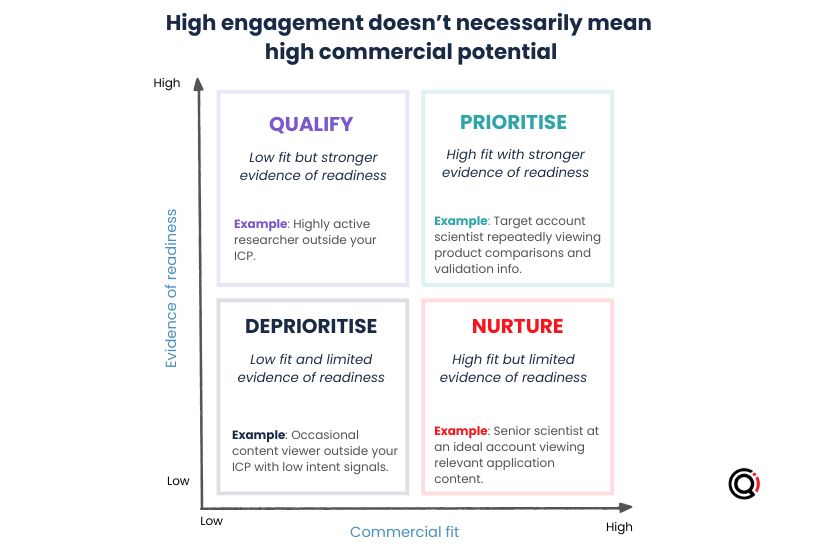
The point is not to create a more complicated formula, but to prevent high engagement activity from disguising poor commercial fit.
What about external signals such as funding?
This is where lead-scoring advice can quickly drift into fantasy.
Life Sciences companies have access to external information that can provide useful commercial context: research grants, funding rounds, facility openings, clinical trial activity, new research programmes, regulatory milestones, or whatever else signals a change in commercial circumstances.
NIH RePORTER [2], for example, provides searchable information on NIH-funded projects. Commercial research intelligence platforms such as Dimensions [3] provide broader grant data and other research information.
Could this information be connected to your CRM? Yes, but does that mean the average marketing team can tick a box and automatically add “new grant awarded” to its lead score? No.
Automating this properly may require a data provider or API, account matching, additional CRM properties and workflow configuration. Establishing that an organisation or researcher in an external dataset corresponds with the right CRM record is itself a significant challenge.
More mature teams can automate parts of this through specialist data providers, APIs and CRM workflows. Still, it is important to distinguish between what is technically possible and what is operationally sensible for your organisation.
Lead scoring needs to account for time
Another common pitfall of lead scoring is allowing behavioural points to accumulate indefinitely. Someone attends a webinar. +10. Downloads an application note. +10. Visits the website several times. +15.
Twelve months later those points may still contribute to a supposedly “hot” score even though the activity that created them has little relationship with current buying readiness.
Different signals lose relevance at different rates. Organisation and application fit may remain relevant for years, but a funding event has a narrow actionable window. A burst of product-comparison activity may be much more time-sensitive.
Can a CRM apply different decay rates?
Increasingly, yes. For example, HubSpot now lets marketers apply decay independently to individual scored events, choosing how much the score falls and whether that happens every 1, 3, 6 or 12 months. It also allows scoring rules to consider only activity within a specified timeframe.
That means a webinar attendance can lose relevance differently from a high-intent product interaction, while stable fit criteria such as organisation type or application need not decay at all.
The challenge has therefore shifted. For teams using modern scoring tools, the question is increasingly less about whether we can make old activity decay and more about what decay rate is commercially justified by their actual buying cycle.
There is no universal decay rate. Look back at won opportunities and examine when different types of engagement occurred relative to opportunity creation. You may not have enough data to calculate a precise figure, but it gives you a better basis for deciding whether a signal should retain its weight for weeks, months or longer.
Stop treating every digital interaction as evidence of intent
Some of the activity marketers can see isn’t even reliable evidence it’s from a human.
Email opens are the obvious example. Apple’s Mail Privacy Protection [4] can privately download remote email content in the background when a message is received rather than when the recipient views it. HubSpot will now pull out ‘bot traffic’ and human traffic as two separate report lines. If your scoring model still awards significant points for opens, we recommend you review it.
Even reliable engagement data needs interpretation. A click is stronger evidence of interaction than an open, but it still doesn’t prove intent. A visit to a pricing-page may be more commercially interesting than a visit to a blog article, but it doesn’t prove there is budget. A demo request or a technical consultation request are much stronger pieces of evidence of buyer readiness, but they still need monitoring as precursors of such.

What to do before you change your lead scoring?
The first question is not whether your sales-ready threshold should be 60, 70 or 100. It is whether the evidence underneath that number has any meaningful relationship with commercial progression.
That is something you can test using the opportunities and customer data already sitting in your CRM.
In the next follow-on article, we discuss how to audit your existing scoring model, find false positives and false negatives, test whether higher scores actually predict progression, and decide how sophisticated your scoring infrastructure really needs to be.
Key takeaways
- A lead score is an interpretation of evidence, not a measure of purchase intent.
- Activity is easy to track, but high engagement does not necessarily mean high conversion potential.
- Individual lead scores can miss how Life Sciences buying really happens.
- The right timeframe for lead decay scores should reflect your buyers’ journeys.
- The real job of scoring is to help you identify commercial progression more reliably.
Want to improve what happens after a lead enters your CRM?
Qincade helps Life Sciences marketing teams improve lead scoring, nurture programmes, CRM processes and sales handover to turn more of the existing demand into pipeline.
Explore our services →
References
- Forrester (2026). Three Realities About B2B Buying Networks. Available at: https://www.forrester.com/blogs/three-realities-about-b2b-buying-networks/ (Accessed: 20 August, 2026)
- National Institutes of Health (NIH). NIH RePORTER. Available at: https://reporter.nih.gov/ (Accessed: 20 August, 2026)
- Dimensions. Grants Data Coverage. Available at: https://help.dimensions.ai/en/articles/9784641 (Accessed: 20 August, 2026)
- Apple. Protect email privacy in Mail on Mac. Available at: https://support.apple.com/en-gb/guide/mail/mlhlp1205/mac (Accessed: 20 August, 2026)