
In this article
- Why landing page optimisation matters for Life Science and Biotech audiences
- How to use behavioural data tools to understand your visitors
- What makes a high-converting headline for a scientific audience
- How to build trust signals that resonate with researchers and clinicians
- CTA, form, speed, and mobile best practices, including conversion benchmarks
- A downloadable Landing Page Optimisation Checklist
Businesses with over 40 polished landing pages generate 12 times more leads than those with fewer than five, according to Hubspot’s research of 4,000 businesses and their lead generation best practices [1].
Your campaign landing page is more than a digital doorway – it’s the handshake that starts relationships with your next customers. But in the Life Sciences and Biotech industries, where audiences are both highly specialized and deeply sceptical, a well-optimized landing page isn’t optional; it’s essential.
Whether you’re targeting researchers, clinicians, or executives, the secret to landing page success in our sector lies in usability, trust and simplicity. With Qincade’s Landing Page Optimization Checklist as your guide, let’s first explore proven strategies that can transform clicks into conversions.
How can we better understand our Life Science landing page audience?
Your audience aka. scientists (mostly) are excited by data, and so it follows that your approach to understanding them is linked to looking at numbers. Tools like Google Analytics (GA4), Hotjar, Mouseflow, Google Optimize, Unbounce etc.and even LinkedIn demographics offer actionable insights into what your visitors need.
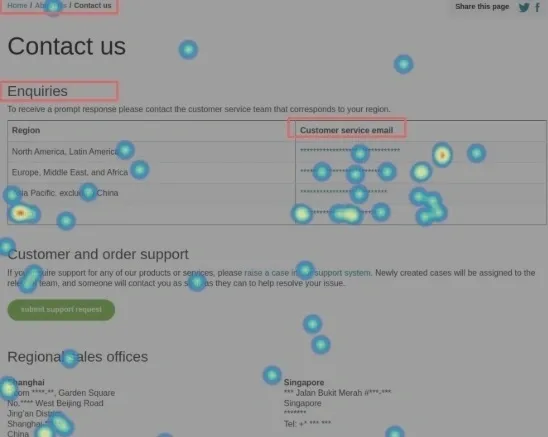
- Top tip: I like to use heatmaps and other reports on scroll depth and click density from tools like Hotjar or Mouseflow to see where visitors linger and what they completely ignore. (A heatmap is a visual data tool that shows where users click, scroll, and linger on a page, helping marketers identify what’s working and what’s being ignored.) This is especially useful if you are optimising an existing page and not building anew since you have some proof from your audience to work with. For example, it’s often really easy to see if users are not reaching your call to actions (CTA)s or if they are confused or frustrated (rage clicks). I like to combine Hotjar-type information with data from GA4 to understand better whether users are engaging deeply or leaving too quickly and which channels are driving users to the page. In addition, goal completions or ecommerce conversions help me identify drop-offs in funnels and determine if CTAs align with user intent.
What makes a high-converting headline for a Biotech landing page?
Your headline and subhead aren’t just copy -they’re your elevator pitch and your SEO passport. Accuracy, relevance, and a touch of urgency are key here.
Don’t forget the visuals too. Since we’re tackling the importance of headlines here, the imagery is also critical. No matter how dull a product or service is, it should have a landing page with a visual impact. The hero section is key. If you are going for a full-screen image or background, make sure to keep an eye on page speed load times and optimize for responsiveness. If you’ve decided to use video, be careful with loading times and make sure that users aren’t distracted from the message you really want to get across. Product images can do well, but our own data suggests that showing images with people in them on B2B landing pages works best.
- Pro tip: Swap out vague statements like “Cutting-edge biotech solutions” for specifics: “Achieve 25% faster results with our advanced assay kits.” Do keep in mind that your H1 heading should always include the keywords that you want to rank for.
- Data says: Research consistently shows that headlines with specific, benefit-driven claims significantly outperform vague ones, for example, try swapping: ‘Cutting-edge biotech solutions’ for ‘Achieve 25% faster results with our advanced assay kits.’

Why do Life Science landing pages need peer-level trust signals?
Trust signals – like testimonials, certifications, and data-rich case studies – are a must. Why? Because scientists trust the opinion of peers, if you are appealing to scientists, you need to bring their voices out of the shadows and onto your web pages. Their voice will resonate with their peers in a way that your business simply won’t.
- Pro tip: Try to feature clear, quantifiable results in testimonials: “Using this solution reduced instrument downtime by 40%.” Although, we know this is not always easy to do when scientists are quite particular about what they want to say.
- Data says: 73% of B2B decision-makers trust peer recommendations when evaluating purchases, far more than vendor websites, search engines, or review sites [2].
How does page simplicity improve Life Science landing page conversions?
A cluttered landing page distracts from your message and adds to user choice fatigue. Use design and simplicity to direct focus and encourage action.
- Pro tip: Remove navigation menus to reduce bounce rates. Instead, use white space and bullet points to guide the reader. Of course, as soon as users click out to another one of your pages, they get their navigation back. Don’t forget that there’s still space in the footer to add secondary CTAs and links.
- Data says: Simplified pages without a navigation bar can double conversion rates. In some published case studies, A/B tests on this single change have returned interesting results such as increases in sign-ups by 100%. (A/B testing is a method of comparing two versions of a webpage to determine which one performs better with your target audience). We’d recommend you test with your own audience and website though.
What makes a CTA effective on a Life Science landing page?
Your CTA is where interest turns into action. It should be impossible to miss and irresistible to click.
- Pro Tip: Use high-contrast colours and actionable text, such as “Get your Trends Report.” You’ll also notice when looking at your on-page optimization data from tools like SEMrush and similar, an error like ‘Links with non-descriptive anchor text’. These can run into hundreds for older sites, and this means that your CTAs are not customized, aka that you have many that simply say ‘download now’ and so on. That’s okay, and sometimes it’s the only CTA to use that makes sense, it’s also not a critical issue for your website overall, but it contributes to a better user experience if your links and navigation are descriptive, conveying that link’s target.
- Data says: Personalized CTAs perform 202% better than generic ones [3]. Personalized calls-to-action are CTAs that are tailored to each individual user’s interests, preferences, and behaviour. If you are using Hubspot, then check out its CTA tool that allows you to adjust CTAs to anonymous and first-time page visitors based on location, device, referral source, or language.
How does page speed affect Life Science landing page conversion rates?
53% of visitors abandon a page that takes more than 3 seconds to load [7], and in Life Sciences, slow pages don’t just lose attention, they lose trust. Life Sciences and Biotech professionals are busy and having a fast-loading website respects their time as well as keeps them engaged whislt they’re researching your solutions.

- Pro tip: Use tools like Google PageSpeed Insights to identify bottlenecks. Compress images, minimize scripts, and use a content delivery network (CDN). A CDN is a system of distributed servers that delivers web content to users based on their geographic location, improving load times.
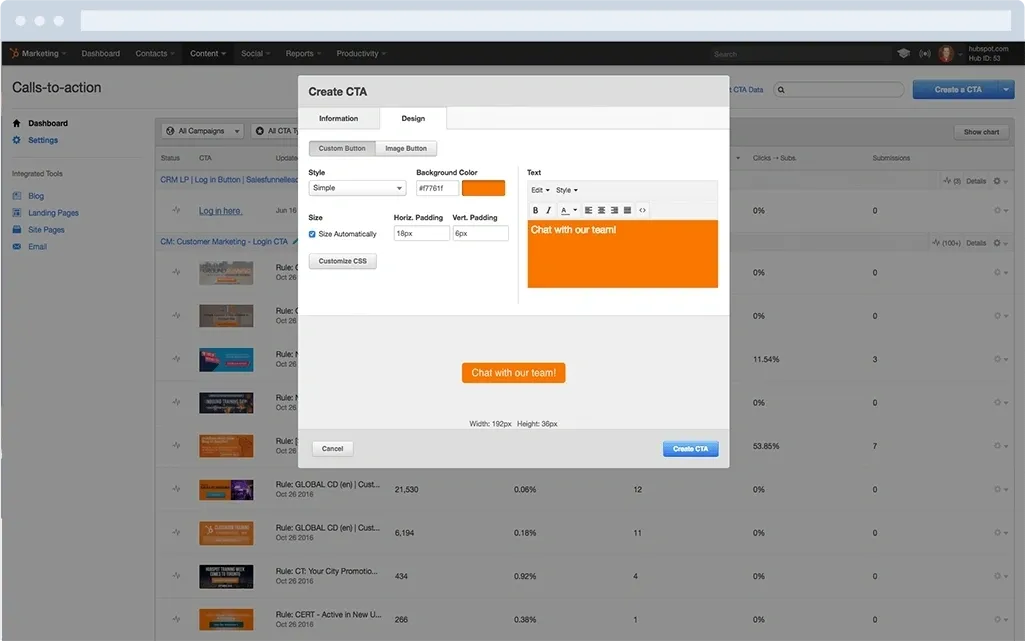
- Data says: A one-second delay in page load times can reduce mobile conversions by 20% [4]. ( A conversion rate is a percentage of landing page visitors who complete the desired action, such as submitting a form or downloading content.) A study by Portent [5] found that pages loading in 1 second see a 40% conversion rate, dropping to 34% at 2 seconds and 29% at 3 seconds. By the time the load time reaches 6 seconds, the conversion rate hits its lowest level. Naturally, certain pages hold greater significance – checkout, login, and home pages should be your top priorities. Beyond these, fast-loading product category pages have the greatest impact on sales due to their high consumer-intent traffic.
How important is mobile optimisation for B2B Life Science pages?
B2B users are still predominantly using desktops for research and initial engagement with other businesses, but the rise in popularity and adoption of mobile-optimized platforms like LinkedIn means that B2B mobile traffic is growing, particularly for top-of-funnel activities (e.g., lead magnet downloads, initial research).
Consider, for example, how directing booth attendees at a tradeshow to one of your landing pages needs to work for them in that moment (with potentially slower than expected Wi-Fi speeds not helping the process) or how critical responsiveness and loading speed is, for those doing some quick product research on the bus or train or standing in a queue at Starbucks waiting for their order.
- Pro tip: Use responsive design principles to adapt layouts and forms seamlessly across devices.
- Data says: 57% of users won’t recommend a business with a poorly designed mobile site [6].
How many form fields should a Life Science lead capture form have?
Lead capture forms are your conversion gateway. Too many fields and you’ll lose those leads. Too few and you might miss key data needed internally to nurture them. This is also connected to an internal conversation or set of conversations that you need to be having with your sales team to make sure that once the leads come in, they are scored for follow-up appropriately and as quickly as possible. At Qincade we offer marketing and sales alignment advice or workshops, as well as work around structuring your lead management process, helping you select attribution models and more. More detail on our Lead Nurturing services.
- Pro tip: Limit form fields to as few as you can get away with. There’s a balance to strike here between how much data you need to gather for you and your sales team to handle leads efficiently versus putting users off by asking them to complete long forms.
- Data says: Recent OptiMonk conversion rate optimization case studies [7], show that strategies deployed by various brands like simplifying checkout pages and reducing form fields resulted in significant conversion rate improvements.
What are average conversion rates for Life Science landing pages?
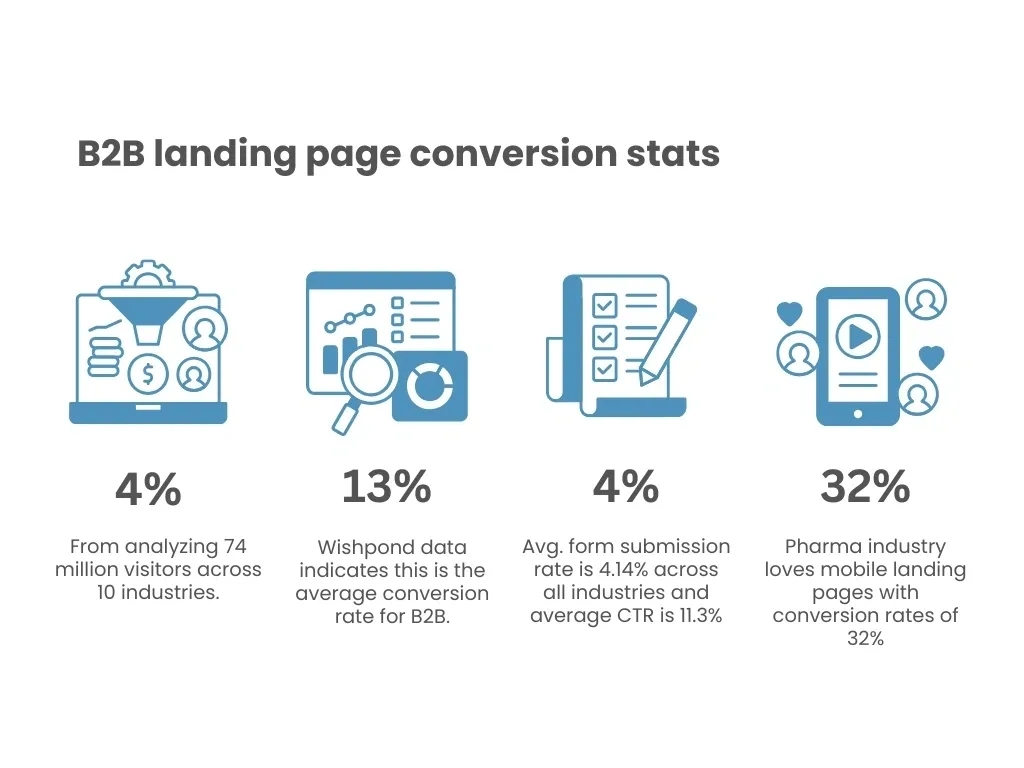
- B2B landing pages have an average conversion rate of 13.28%. [8]
- According to Unbounce, the average form submission rate for landing pages is 4.14% across all industries. Click-through rates for landing pages average at 11.3% [9].
- Instapage conducted some of their own research that showed that mobile landing pages perform best within the pharmaceutical industry, with a conversion rate of over 32%. Other strong performers include internet software, media, and e-commerce, with rates between 25% and 26% [10].
Key takeaways
- Life Science landing pages must earn trust before they earn clicks, the addititin of peer testimonials and quantified results outperform brand claims with scientific audiences.
- Behavioural data tools like Hotjar and GA4 reveal what copy alone cannot, you can use scroll depth and heatmaps to identify CTA drop-off before making changes.
- Removing navigation menus from landing pages can double conversion rates, we recommend you A/B test this change on your highest-traffic pages first.
- Form fields should be as few as your sales team can work with, we recommend that you align with your sales team on minimum viable data before shortening forms.
- Page speed below 3 seconds is non-negotiable – a one-second delay in load time can reduce mobile conversions by 20%.
- Personalised CTAs consistently outperform generic ones, and even simple audience-segment tailoring improves performance meaningfully.
Ready to optimise your landing page?
Your landing page is a reflection of your brand, your science, and your promise to potential customers. By applying these evidence-backed strategies, you’re not just optimizing a webpage – you’re growing trust in your brand and demonstrating its credibility.
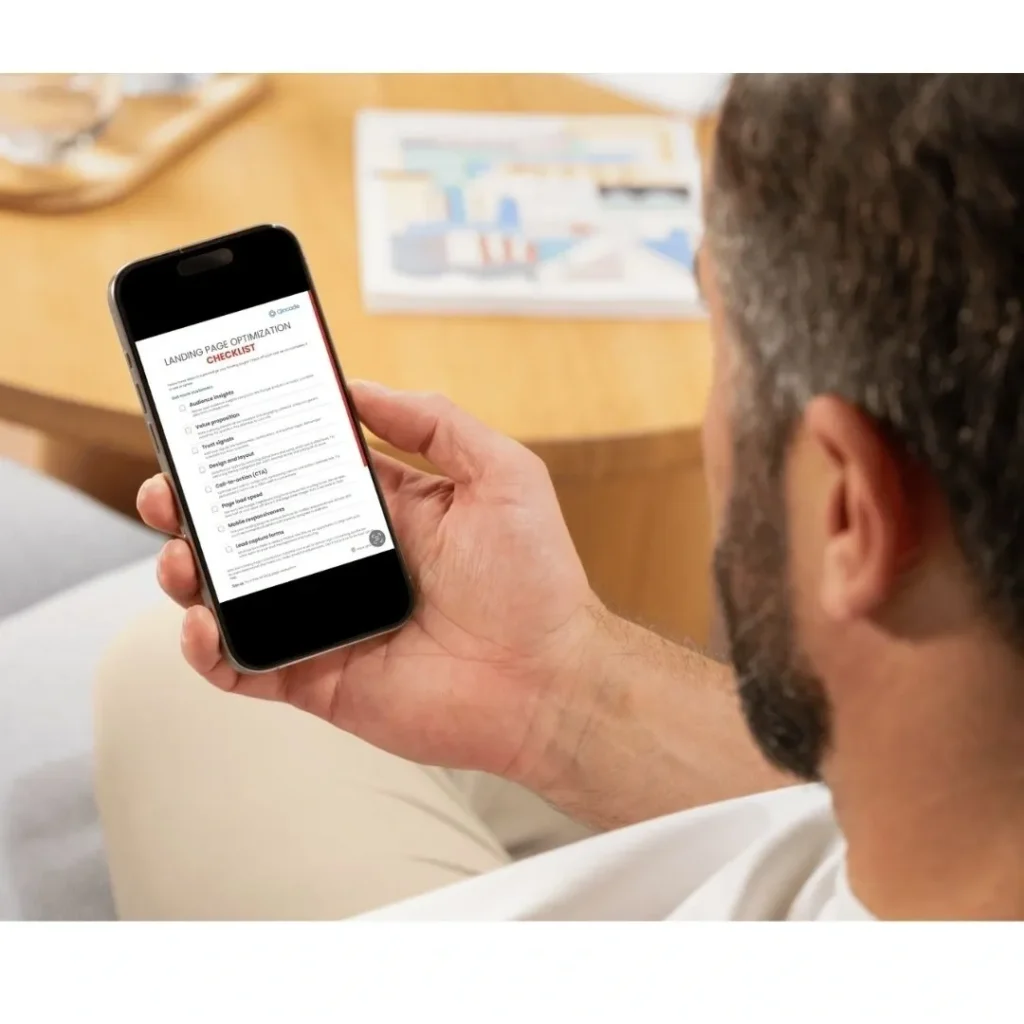
Qincade’s one-page Landing Page Optimisation Checklist walks you through every key element covered in this article, ready to use on your next page review. → Download the Landing Page Optimisation Checklist
If you’d prefer an expert eye on your page, Qincade offers a free landing page evaluation for Life Science and Biotech companies. → Claim your free landing page evaluation
References
1. HubSpot (n.d.). Lead Generation Lessons from 4,000 Businesses. HubSpot. [https://www.hubspot.com/hubfs/docs/ebooks/lead-generation-lessons-from-4000-businesses.pdf]
2. Reddit & SurveyMonkey (2026). The Hidden B2B Journey. Reddit for Business. [https://www.business.reddit.com/resources/the-hidden-b2b-journey]
3. HubSpot (2022). Personalized Calls-to-Action Convert Better. HubSpot Blog. [https://blog.hubspot.com/marketing/personalized-calls-to-action-convert-better-data]
4. Google (2016). Why & How to Focus on Mobile Page Speed. Think with Google. [https://www.thinkwithgoogle.com/marketing-strategies/app-and-mobile/mobile-page-speed-data/]
5. Portent (2022). Site Speed Is (Still) Impacting Your Conversion Rate. Portent. [https://portent.com/blog/analytics/research-site-speed-hurting-everyones-revenue.htm]
6. Google (n.d.). Consumer Insights. Think with Google. [https://business.google.com/en-all/think/consumer-insights/]
7. OptiMonk (n.d.). Conversion Rate Optimisation Case Studies: 6 Success Stories and Lessons Learned. OptiMonk Blog. [https://www.optimonk.com/conversion-rate-optimization-case-studies/]
8. Wishpond (n.d.). Landing Page Benchmark Report: Conversion Rates from 146 Landing Pages. Wishpond Blog. [https://blog.wishpond.com/post/115675435109/landing-page-benchmark]
9. Unbounce (n.d.). Conversion Benchmark Report. Unbounce. [https://unbounce.com/conversion-benchmark-report/]
10. Instapage (n.d.). The Mobile Landing Page Report: An Inside Look at Conversion Rates Across Industries. Instapage. [https://instapage.com/blog/mobile-landing-page-report/]