
In this article
- What do we know about how buyers use AI to research suppliers
- Why AI visibility matters even when buyers don’t click
- How to make scientific product information easier to assess
- Where to start and how to measure progress
By the time a buyer contacts your sales team, your brand may already be their preferred supplier, or significantly behind a competitor.
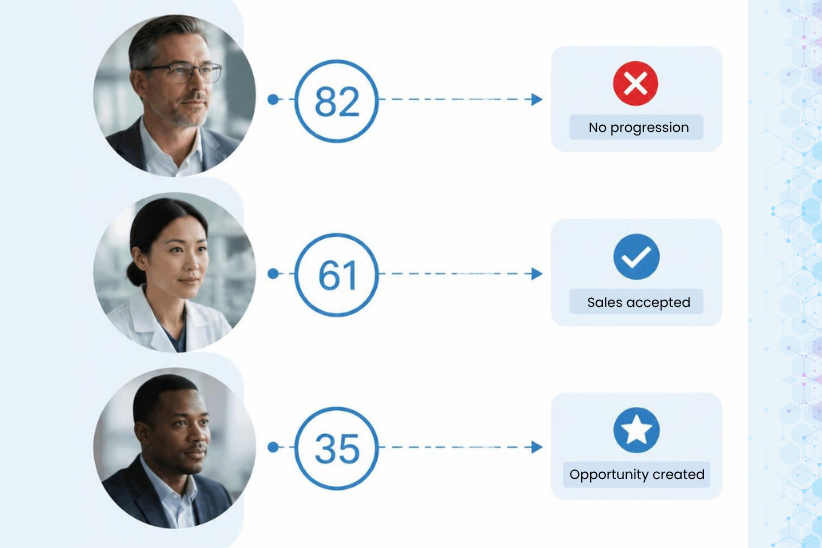
In 6sense’s survey of more than 4,000 B2B buyers, 94% of buying groups researched and ranked suppliers before speaking to sales, and 77% bought from their initial favourite.[1] For brands, this highlights the importance of being considered early, while buyers are still gathering information and evaluating their options.
AI tools have become part of that early research. If competing products appear in AI-generated answers and yours do not, those competitors gain an introduction you miss.
The research phase for a Life Sciences purchase can span months, sometimes well over a year. During this period, potential customers may be actively evaluating suppliers and technologies without marketers knowing, because much of that activity happens outside their tech stack.
Just as SEO continues to support product and brand discoverability, AI search has become another channel that marketers need to consider. The challenge is ensuring that AI tools can find and cite your products accurately. I like to think of AI tools as a new type of audience that have been introduced and one that marketers have to learn to cater for.
How are B2B and scientific buyers using AI for research?
Available studies on the use of AI give us a good indication of how the search process is changing.
In findings from a Gartner survey of 645 B2B buyers published in May 2026, 45% said they had used generative AI during a recent purchase, primarily to gather information about vendors and products.[2]
Another survey of 1,862 technology buyers by TrustRadius in 2026 found that 63% used AI during their purchase journey. Among those users, 94% checked its responses at least some of the time.[3] Although these surveys covered different markets rather than Life Sciences specifically, they indicate a shift in how B2B buyers conduct research.
AZoNetwork offers evidence closer to scientific purchasing. Its 2026 survey summary reports a 68% year-on-year increase in AI use for comparing products. It also reports that manufacturer websites influenced 88% of respondents’ purchases and search engines 87%.[4] The public summary does not establish an adoption rate specifically for Life Science buyers, but it does challenge the idea that AI makes supplier websites irrelevant.
For Life Science marketers, these findings make a strong case for including AI discoverability in their broader content and search strategy.
Buyers can notice you before you notice them
An AI answer can introduce a buyer to your company alongside your competitors without sending them to any external websites. Buyers can create shortlists, or look your brand up separately and discuss several options with a colleague.
For Life Science marketers, the opportunity is to increase the likelihood of being considered before a technical or sales enquiry arrives.
To help you assess your current visibility, we’ve created a prompt log and a quarterly scoreboard linked in our AI search visibility guide for Life Science marketers. You should adapt these prompts to your brand and track whether your products are mentioned, recommended or cited in AI answers, alongside website traffic and enquiries.
How do you make your products easier to discover?
Google says that product pages need to be indexed and eligible for a search snippet to appear as supporting links in AI Overviews or AI Mode. There are no additional technical requirements.[6] Its optimisation guidance also says that special AI text files are unnecessary.[5]
That is a useful starting point for budget allocation. Check access and improve the information buyers need and already ask for before commissioning a separate programme of “AI content” or layering more sophisticated AI capabilities into your marketing operations.
For instance, imagine your ideal customer has typed the following question into their AI platform of choice: “Which library preparation kits have evidence for low-input, formalin-fixed paraffin-embedded samples?”
A product page promising exceptional performance gives the buyer little basis for comparison. A more useful result would identify the sample material, input requirements, workflow, instruments used, results and limitations. Any performance claim should retain the conditions under which it was established.
Specific numbers, supported by named sources and appropriate qualifications, make technical claims easier to assess and reference. Consider including data on sensitivity, throughput, timelines, percentages and outcomes.
You can publish ungated HTML summaries of your Application Notes, validation data and posters, with the methods and key results available as text, while keeping the full PDFs gated if these form an important part of your lead capture strategy.
To start, review your most commercially important product pages against the questions your sales and application specialists already receive. Where the evidence sits behind a form, consider publishing an accessible summary. Include enough detail for a reader to judge relevance; a teaser paragraph will not do that job.
This is an editorial and commercial judgement, not a proven formula for earning citations. Publish information that helps your buyers make better decisions during the consideration phase, whether they read it directly or encounter it through an AI answer.
For a detailed guide on making your content findable and accessible to AI search tools, read the Foundation section of our AI search visibility guide for Life Science marketers.
What should Life Science marketers do first to improve AI search visibility?
Choose a commercially important product or application area, and start by collecting questions from recent customer enquiries, sales conversations and application support discussions. Include questions about suitability and limitations as well as supplier comparisons.
Run a repeatable set of these questions through several commonly used AI tools to simulate how your buyers might research suppliers. Record the AI tool, date, whether your competitors appear, whether your brand or website appears, and any inaccuracies in how your products are described. You can use our free template log for this.
Repeat the same checks once a month, starting new chats in each tool whilst logged out. Record brand mentions, recommendations and website citations separately.
A single lookup or screenshot is not enough to establish your brand’s visibility in AI search. SparkToro and Gumshoe’s research found substantial variation in recommendation lists across repeated prompts.[7] A small manual exercise can expose obvious gaps, but it cannot estimate your share of all buyer searches. A simple scoreboard can, however, help you track changes to your brand’s AI visibility over time.
You can useQincade’s free prompt log and quarterly scorecard to organise your findings, monitor changes and prioritise improvements. Both are included in our AI search visibility guide for Life Science marketers, which provides practical steps to help you improve your AI search visibility.
How do you know if your AI search visibility is improving?
Our advice is to measure progress without inventing attribution and to keep the reporting focused on three questions:
- Are we appearing in relevant answers? Report mentions, recommendations and citations separately, with the number of checks and results split out by each AI tool. Google’s Search Console’s Generative AI performance reports also show impressions for your URLs within its AI features.[8]
- Are the answers accurate and useful? Track errors in specifications, applications and product descriptions. More visibility alongside more misleading claims is a problem worth investigating.
- Is there evidence of commercial value? Review identifiable AI referrals and the enquiries they produce. Ask prospects how they found you, for example through a question on your enquiry form or during initial sales conversations, and record AI-assisted research when they mention it. Where possible, track these enquiries through to qualified opportunities and pipeline.
Attribution is difficult here, because referral tracking will miss some visits: Similarweb notes that AI traffic can arrive without referral information and appear as direct traffic.[9] Branded search can provide another clue, but campaigns, events and other activity affect it too. Neither measure isolates AI’s contribution to revenue.
Before you begin, agree with your team on what you want to achieve. For one brand, the priority might be correcting how a product is described. For another, it might be appearing in supplier comparisons for a specific application. Each objective will require different measures of success.
AI visibility can help you earn a place on the shortlist
AI search now adds another source of information that buyers can draw on when researching a purchase and forming a shortlist. An AI tool or assistant can introduce your company, compare your products with competitors’ and summarise the available evidence before someone reaches your website. That makes both your brand’s visibility and the accuracy of those answers important.
The fundamentals of good content marketing remain: understand what buyers need at each stage of their decision, answer their questions clearly and support your claims with evidence. What’s changed is that marketers now have an additional channel from which that information reaches buyers.
Start by finding out what AI tools already say about your brand.
Qincade’s free AI search visibility guide for Life Science Marketers provides 14 practical steps to help you improve discoverability, strengthen credibility and measure progress. It also includes a prompt log and quarterly scoreboard to help you identify gaps and prioritise improvements.
Key takeaways
- AI is increasingly part of B2B supplier research, although published research specific to Life Science purchasing remains limited.
- Buyers may encounter and evaluate your brand through AI without visiting your website, making AI visibility worth monitoring separately.
- Useful scientific content explains product suitability, supporting evidence and limitations. Visibility has limited value if an AI-generated answer misrepresents your product or service.
- Start with one commercially important product category. Repeat relevant buyer questions and track mentions, recommendations, citations and accuracy separately.
- Assess visibility alongside enquiries and buyer feedback. An increase in AI mentions does not, by itself, demonstrate commercial value.
References
- 6sense (12 November 2025). The Timeline for Influencing B2B Buyers Is Shrinking: Insights From 6sense’s 2025 Buyer Experience Report. Company press release distributed through Business Wire.
- Gartner (20 May 2026). Gartner Survey Finds 69% of B2B Buyers Turn to Sales Reps to Validate AI-Generated Insights.
- TrustRadius / HG Insights (15 July 2026). TrustRadius 2026 B2B Buying Disconnect Report Reveals AI Has Changed How Buyers Research, But Not What They Trust.
- AZoNetwork (4 February 2026; updated 5 February). State of Scientific Purchasing 2026.
- Google Search Central. AI features and your website. Live documentation.
- Google Search Central. Google’s guide to optimizing for generative AI features on Google Search. Live documentation.
- Fishkin, R., SparkToro (27 January 2026). NEW Research: AIs are highly inconsistent when recommending brands or products; marketers should take care when tracking AI visibility. Research conducted with Gumshoe.
- Maoz, H. and Samet, M., Google Search Central (3 June 2026; rollout note updated 31 August). Introducing Search Generative AI performance reports in Search Console.
- Zohar Basteker, M., Similarweb (3 September 2026). AI Referral Traffic by Industry: What 770 Million Monthly Visits Reveal.
Sources checked on 16 November 2026.