In this article
- How to define a minimum viable CRM data model for Life Science marketing
- A four-step process to clean and normalise your contact database
- How to map segments to content, messaging, and calls to action
- Automation rules and dynamic segmentation for ongoing pipeline generation
- The seven most common CRM segmentation mistakes and how to fix them
In part 1, we outlined a three-layer segmentation model based on role, scientific workflow, and buying readiness.
This second article focuses on execution. It walks through how to build the data model, clean your CRM, and translate all those efforts into successful lead nurture programmes.
What does a minimum viable CRM data model look like for Life Science marketing?
Many Life Science companies want better nurtures, but their databases cannot support meaningful segmentation. So before writing your next email sequence or even a newsletter, fix the underlying data model. This does not require hundreds of fields. It requires a small set of well-defined fields that are consistently populated.
In practice, achieving this consistency is not as simple as adding new fields to the CRM. Data quality rarely improves through one-off clean-up projects. Instead it requires a small number of operational mechanisms working together: structured lead capture, automated normalisation of messy fields such as job titles, and clear ownership of key data fields between marketing and sales. Without these operational guardrails, even a well-designed data model will quickly drift back into inconsistent use.
The goal therefore is not perfect data across the entire database. A more realistic objective is reliable segmentation data for the contacts that actually matter: active leads, evaluators, opportunities, and high value customers.
What firmographic fields should a Life Science CRM include?
At the account level, ensure the following fields exist and are controlled because these signals help prioritise commercial effort.
- Organisation type
- Segment / subtype (driven by your GTM priorities).
- Region and country
- Lab capacity proxy (such as “<5 scientists / 5–20 / 20+” or “Single lab / Department / Multisite organisation” if you can’t get headcount).
What contact-level fields are essential for Life Science lead segmentation?
At the contact level, standardise:
- Role category (derived from job title mapping rules).
- Decision influence (This field can initially be inferred from job role category and later refined through sales input or opportunity data.)
- Channel preferences and permissions (email marketing consent, phone, webinar attendance, event participation, preferred communication channels (LinkedIn, etc.)).
How do you capture scientific workflow and application data in your CRM?
For each contact (or at least at the account level), strive to capture the following:
- Primary application cluster from your controlled list. (e.g. NGS library preparation, western blot, cell imaging, flow cytometry etc.)
- Secondary applications where relevant, as these allow for cross-sell opportunities.
- Platform/instrument ecosystem in use.(This information can be captured through lead capture forms, technical consultations, sales conversations and product registration or support interactions.)
- Key operational constraints (GMP environment, low input samples, high throughput/automation requirements, etc.).
In reality, this information is rarely perfect, but even partial coverage improves segmentation.
What behavioural and lifecycle data does a Life Science nurture programme need?
For nurture programmes to work reliably, the CRM also needs a few behavioural and lifecycle fields:
- Lead source and first touch attribution: this helps to understand which channels generate meaningful contacts.
- Lifecycle stage should be documented, mapped and jointly agreed between marketing and sales. For example, a marketing qualified lead (MQL) might require a defined engagement threshold plus fit criteria, someone tagged as an ‘evaluator’ might require interaction with evaluation stage content or a demo request.
- Engagement score and intent indicators updated automatically from activity. Platforms such as HubSpot allow basic scoring models based on behavioural signals like page views, form submissions, or repeated engagement with high intent pages. Your scoring model does not need to be complex, it simply needs to reflect meaningful evaluation behaviour.
If these fields are missing, improving the data model is usually a better starting point than launching additional nurture campaigns.
How do you clean and segment a messy Life Science CRM database?
Once the data model is defined, the next step is cleaning and normalising existing records.
The initial clean up does not have to take months. Even a short focused effort can significantly improve segmentation quality, but you will have to keep coming back to this project time and again to ensure robustness of your segmentation approach.
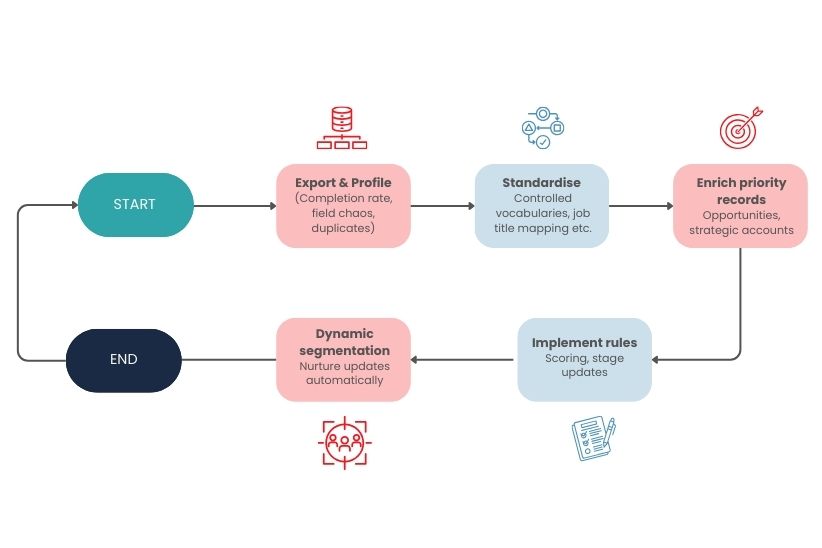
Step 1: Export and profile the data
Start with a representative sample such as the most recent 5,000 to 10,000 contacts.
For each key field:
- Measure completion rate (% filled).
- Count the number of unique values (especially for “job title”, “application”, “organisation type”).
- Identify any obvious issues: free text chaos, inconsistent naming, duplicates.
Job titles and organisation types are often the most chaotic fields. Profiling them highlights where normalisation rules will have the most impact and doing shows you where your segmentation would fall over today.
Step 2: Standardise and normalise
Next, define controlled vocabularies for core segmentation fields.
- Organisation type
- Role category
- Application clusters
- Lifecycle stages
Then apply simple mapping rules to normalise, for example:
- “Senior Scientist” to Bench Scientist
- NGS related inputs to genomics
- Antibody heavy purchase history to protein analysis
The goal is not perfection. Standardising roughly 70 to 80 percent of records is usually sufficient to begin meaningful segmentation, the edge cases can be left for another day.
Step 3: Enrich the gaps that matter
Attempting to enrich every record is rarely efficient. Focus on segments where better data directly supports revenue.
Priorities often include:
- Strategic accounts
- Active opportunities
- Recently engaged evaluators
- High value customers
Use enrichment sources:
- Order history
- Opportunity data
- Webinar topics attended
- Conference participation
- Updated lead capture forms that include workflow or application questions
Over time these sources gradually improve database quality.
Step 4: Implement lifecycle and behaviour rules
Finally, configure rules that update lifecycle and intent automatically.
Most marketing automation platforms allow rules such as:
- Assign lifecycle stage based on lead source
- Promote contacts when defined engagement thresholds are crossed
- Reduce engagement scores after extended inactivity
Now your segments will update dynamically as people move through their journey, instead of fossilising in your database after a one-off marketing push.
How do you turn CRM segments into lead nurture programmes in Life Science marketing?
Segmentation is the prerequisite for meaningful personalisation. Without clear segments defined by workflow, role, and buying stage, even sophisticated marketing automation or AI tools simply distribute the same content more efficiently rather than making it more relevant.
A practical starting point is to build a decision tree that progressively narrows the audience.
For example:
Database → lifecycle stage → application cluster → role category → intent level
This process produces actionable end segments such as:
- New genomics bench scientists with low intent
- Cell based assay evaluators with medium intent
- Instrument opportunities involving procurement or PI level decision makers
Each segment should receive a different narrative, content mix, and call to action rather than a slightly modified version of the same generic newsletter.
Mapping segments to content, messaging, and calls to action
A practical way to apply segmentation is to define core segments and map each one to a clear objective, content mix, and call to action.
For example:
| Segment example | Primary objective | Content mix | Typical CTA |
| New leads – Genomics – Bench scientists – Low intent | Make them aware, earn trust, and uncover real projects. | Protocols, troubleshooting guides, short “how we solved X in NGS” articles, ondemand howto webinars. | “View full protocol”, “Download troubleshooting guide”, “Tell us about your NGS setup”. |
| Evaluators – Cell based assays – Lab managers – Medium intent | Reduce perceived risk and shorten evaluation cycles. | Workflow comparisons, protocol compatibility guidance, performance app notes, and evaluation kit offers. | “Book a 30min workflow consult”, “Request an evaluation kit”. |
| Open opps – Highvalue instruments – PI/Procurement – High intent | Justify budget and derisk purchase decision. | ROI calculators, case studies, implementation plans, service & training overviews. | “Download business case pack”, “Schedule an implementation planning call”. |
| Existing customers – Reagents – Bench scientists – Medium intent | Increase depth of use and cros-ssell adjacent products | Optimisation tips, application expansion content, “recipes”, new kit announcements. | “Watch optimisation webinar”, “Try this kit with your current platform”. |
| Lapsed customers – Any product – Mixed roles – Low intent | Diagnose churn and selectively reengage | Short survey, “best of” content, new product highlights with clear differentiation. | “Tell us what changed”, “See what’s new since you last ordered”. |
Each segment should ideally have its own nurture track with cadence, narrative, and sales handoff thresholds tailored to its position in the buying journey. In practice this often means breaking larger content assets such as white papers or application notes into modular sections so the most relevant evidence, protocols, or case studies can be assembled for each buyer segment.
How do you keep Life Science CRM segments up to date using behavioural signals?
Static segments defined once decay quickly. Scientists change roles, adopt new platforms, move labs, and progress (or stall) in their evaluation. Segmentation needs to move with these changes to stay robust and useable.
Behaviour based lead scoring and promotion signals
Start by writing down all of the events/behaviours meaningful to your business that would promote a contact inside your CRM, for example:
- Visits to pricing or specification pages
- Demo or trial requests
- Repeated engagement with decision stage content (e.g. (buying guides, case studies, ROI tools) within a defined time window
At the same time define signals that would demote a contact, for example:
- No interaction for several months
- Email unsubscribes or hard bounces
- Sales disqualification
Guardrails to prevent nurture conflicts
Without clear rules, contacts can easily end up enrolled in multiple conflicting nurture streams.
Practical guardrails include:
- High intent programmes override low intent nurtures
- Opportunity stage contacts exit general marketing programmes
- Customers are excluded from pre-purchase education sequences
These rules can usually be implemented through workflow suppression lists and lifecycle based enrolment criteria.
How do you build automated lead nurturing workflows for Life Science and Biotech?
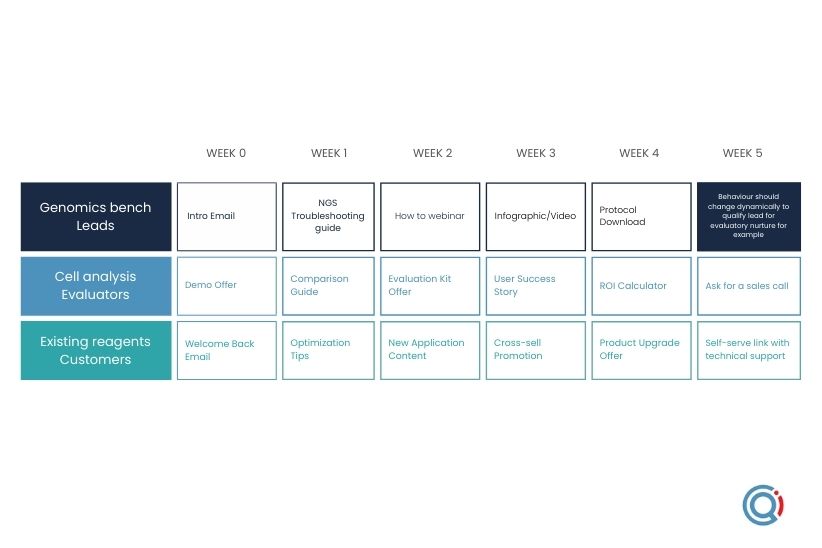
By this point, you know who’s in which segment and what each group of contacts should receive. The last step is to turn that strategy into concrete journeys over time. What does Week 0, Week 2, Week 4 actually look like for different segments that enter your system on the same day?
A useful way to see the contrast is to lay your nurtures out as swimlanes: time runs left to right, and each lane represents a different segment. The cadence might be similar, but the story, content format, and CTA are completely different for a new genomics bench lead, a cell analysis evaluator, and an existing reagent customer.
Example CRM automation rules for segmentation and nurture programmes
Marketing automation platforms rely on simple conditional logic; example rules might include:
IF
Lifecycle = New lead
AND Application cluster = Genomics
AND Role category = Bench Scientist
AND Intent = Low
THEN
Enrol in “Genomics Bench – Awareness” nurture with one email per week for six weeks.

-----

IF
Lifecycle = Evaluator
AND Product interest = Instrument Family X
AND Intent = High
THEN
Remove from all generic nurtures, enrol in “Instrument X Evaluation” sequence, notify assigned sales rep, and schedule follow-up tasks.

-----

IF
Lifecycle = Customer
AND Product purchased = Reagent Kit Y
THEN
Enrol in “Kit Y Optimisation & Expansion” nurture; trigger cross-sell offers for complementary kits after a defined usage period.
Even in a simple marketing automation platform, this structure is achievable if your underlying data model is sound.
What are the most common CRM segmentation mistakes in Life Science marketing?
Several recurring mistakes limit the effectiveness of Life Science and Biotech nurture programmes.
MISTAKE 1: Over-reliance on crude firmographics
Using “academic vs industry” or event “technical vs economic buyer” as the primary segmentation axis ignores scientific workflow, platform, and role -based context. Two academic labs may have very different needs if one focuses on imaging and the other on sequencing.
Do this instead: Make application area and workflow your primary segmentation lens, while organisation type and geography refine the messaging.
MISTAKE 2: Treating scientists as one persona
A bench scientist troubleshooting western blots is not looking for the same information as a lab manager planning CAPEX, or procurement comparing suppliers.
Do this instead: Build distinct content and nurture tracks for at least three audiences: bench level users, lab managers/core facilities, and decisionmakers/procurement.

MISTAKE 3: Same nurture for prospects and customers
Sending awareness stage nurture to existing customers wastes their time and your expansion opportunity. It also signals you don’t understand their relationship with you.
Do this instead: Use lifecycle stage as a hard gate on every nurture. Customers belong in optimisation, expansion, and advocacy streams not in “what is X technology?” type of primers.
MISTAKE 4: Static segmentation
Running a oneoff segmentation project and never updating it is almost worse than doing nothing. Within a few months, roles, platforms, and buying stages will have shifted.
Do this instead: Treat segmentation as a living system. Behaviour driven lifecycle and intent updates should be baked into your automation from day one, so contacts dynamically move between segments as their reality changes.
Why is CRM segmentation a strategic priority for Life Science marketing teams?
Many teams try to improve performance by producing more content or testing subject lines. In many cases, the bigger commercial opportunity lies in improving segmentation first.
Strong segmentation improves relevance, aligns marketing with scientific workflows, and supports earlier and more effective commercial conversations.
A practical segmentation programme requires:
- Three layers of segmentation
- A minimum viable CRM data model
- A structured database clean-up process
- Segment specific nurture strategies
- Behaviour-driven lifecycle updates
Even a simplified version of this blueprint can help Life Sciences marketing teams move beyond generic outreach and build more relevant programmes that support stronger pipeline generation.
If your CRM still behaves like a contact database rather than a pipeline engine, the issue is rarely the platform. It is how segmentation, workflows, and content are structured.
The Life Science Lead Nurturing System is designed to turn existing CRM and automation tools into a structured, revenue generating nurture engine.
Key takeaways
- Meaningful segmentation requires three data layers: firmographics, scientific workflow, and buying readiness.
- You don’t need perfect data. Standardising 70–80% of key records is enough to start.
- Segmentation should be a living system, updated automatically through behavioural signals.
- Generic nurture sent to customers, evaluators, and new leads alike is one of the most common and costly mistakes in Life Science marketing.
If your CRM still behaves like a contact database rather than a pipeline engine, Qincade’s Life Science Lead Nurturing System is designed to change that. → Explore the Life Science Lead Nurturing System
In Part 1 of this series, we introduced a three-layer CRM segmentation model for Life Science marketing — covering role, scientific workflow, and buying readiness. This article focuses on execution.