
In this article
- How to audit your existing lead-scoring system
- How to test whether higher scores predict progression
- How to find the good prospects your model misses
- How to compare individual and account-level signals
- When more sophisticated scoring isn’t worth doing
To find out whether your lead scoring model is working, you don’t need to rebuild it. It’s sufficient to start with evaluating the opportunities you’ve already created and the customers you’ve already won.
You’ll know that your scoring model is useful if higher scores generally correspond with a greater likelihood of those leads progressing to commercially meaningful conversations. It should also identify valuable prospects early enough to place them in a relevant nurture, alert sales to review the account, provide more specific technical information or coordinate activity across several contacts at the same organisation.
If higher scores do not correspond with progression, or nobody acts differently when a valuable prospect is identified, adding more rules and signals will only make an ineffective system more complicated.
As we explored in our companion article, “Why your lead scoring model may be measuring the wrong thing”, a score is an interpretation of the evidence available to you and an expression of the rules you’ve written. The only way to know whether those rules are useful is to test them against what happened in your pipeline.
How do I start auditing my lead scoring system?
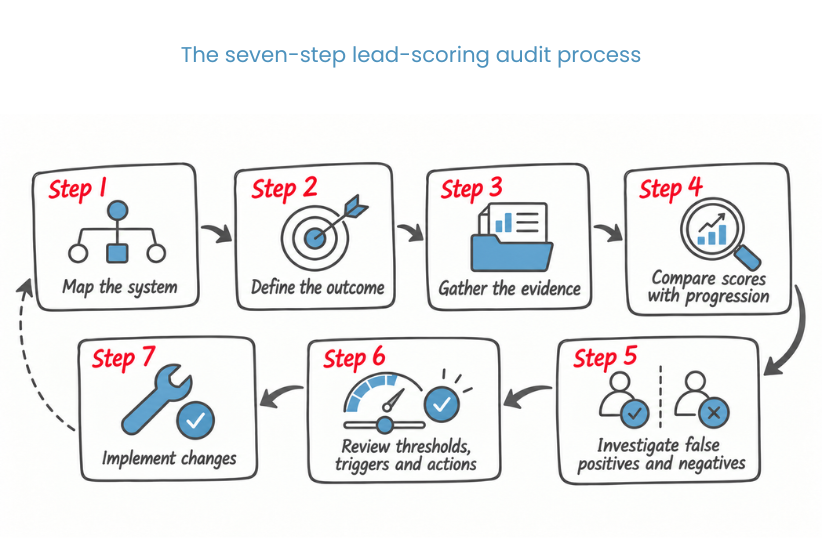
Before analysing conversion rates or changing point values, establish how scoring and qualification works in your CRM today.
You may have one lead score, but it’s increasingly common to find several. There might be separate fit and engagement scores, contact and company scores, product-specific scores or older custom scores running in the background. Qualification logic can also sit outside the scores themselves, in workflows that change lifecycle stages, enrol contacts into nurture or trigger a sales handover.
So the first task is to map the system.
If you’re using HubSpot, start in Marketing → Lead Scoring, where you can identify the contact and company scores currently set up. Open each score to review the criteria contributing to it and where the score is being used elsewhere in HubSpot, including any workflows that rely on it.
Then inspect those workflows to understand what the score triggers. You might discover, for example, that an engagement score of 70 doesn’t create an MQL on its own. A workflow requires an engagement score above 70 and a fit score above 40 before changing the lifecycle stage and notifying sales.
Finally, check for older scoring fields. In HubSpot, go to Settings, then Properties, and search your contact and company properties for words such as score, fit, engagement, intent, qualification and MQL. Custom scoring fields created years ago can still be feeding workflows, even if they don’t appear in the current Lead Scoring tool. For each one you find, check where it’s used before deciding whether to keep it.
Map what you find in Excel capturing the following info:
| Score or rule | What feeds it? | Where is it used? | What does it trigger? | Still needed? |
| Contact engagement | Web, email, forms | MQL workflow | Contributes to MQL at 70 | Test |
| ICP fit | Role, company, geography | MQL workflow | Must exceed 40 | Test |
| Company engagement | Associated contact activity | Sales account view | Account prioritisation | Test |
| Legacy lead score | Older behavioural rules | Nothing identified | Nothing | Review/retire |
This exercise may reveal that you don’t really have a lead scoring model. You have several overlapping mechanisms deciding who gets attention.
This is important because auditing each score independently can give you the wrong answer. A contact might have a high engagement score but poor fit, while the workflow responsible for sales handover uses engagement alone. Elsewhere, a company-level score might be signalling that the account is an excellent fit. Ultimately, the thing you need to audit is the combination of scores and rules that drives the decision.
Once you understand that system, start interrogating the individual criteria:
- What is this signal trying to represent: fit, engagement, readiness or account activity?
- Why does it have this weighting?
- Is that weighting based on anything you’ve observed in your own pipeline?
- Does its influence reduce as the activity gets older?
- What action does it ultimately influence?
If reaching a score of 70 triggers an MQL handover, but nobody can explain why 70 represents greater commercial readiness than 50, that threshold needs a review. But don’t start changing it yet.
Once you have a map that summarises what you score, what feeds each score, how the scores interact and which commercial decisions they influence, you can test whether the system bears any relationship to what actually progresses through your pipeline.
Establish if higher scores correspond with progression
Once you’ve mapped how scoring and qualification work, the next question is whether the people your system prioritises are more likely to progress through to a commercially meaningful conversation.
You don’t need sophisticated analysis to start answering this and you don’t need to monitor scores month by month.
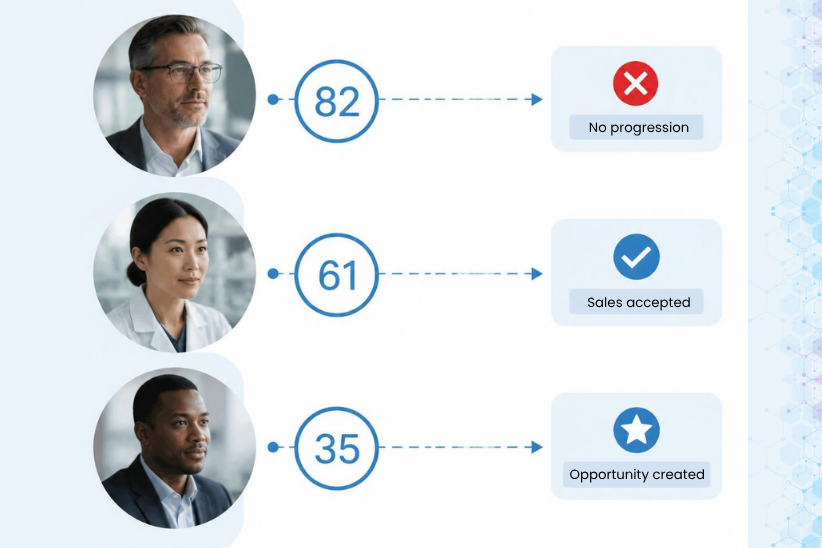
Take a meaningful sample of leads (e.g. 20) that reached your qualification threshold over a period that reflects your sales cycle, perhaps the last 6–12 months. Look at what happened next. How many were accepted by sales? How many led to meaningful commercial conversations or opportunities? How many went nowhere?
Then compare that with lower-scoring leads that didn’t qualify.
For a straightforward numerical score, the picture might look something like this:
| Score band | Sales accepted | Opportunity created |
| 0–24 | 2% | 0.5% |
| 25–49 | 7% | 2% |
| 50–74 | 24% | 9% |
| 75+ | 51% | 23% |
Illustrative data only.
You’re not trying to prove that a score predicts revenue- its whole job is to help your marketing team prioritise leads.
If higher-scoring leads are consistently more likely to be accepted by sales or become opportunities, the model is doing something useful. If your highest-scoring leads routinely go nowhere while lower-scoring, better-fit prospects progress, you have a reason to look more closely at what the model is rewarding.
What happens if you have several scores?
If your mapping exercise uncovered separate fit, engagement, company or other scores, don’t try to analyse every possible combination.
We suggest, starting with the scores and rules that influence an important action, such as an MQL handover, sales alert, nurture route or account prioritisation.
Then look for obvious patterns:
- Are highly engaged but poor-fit leads regularly reaching sales?
- Are strong-fit prospects being held back because they haven’t accumulated enough activity?
- Do accounts that eventually progress tend to show activity across several contacts that your individual scoring overlooks?
These observations tell you something very useful without you needing to design a statistically perfect model.
Work with the history you have
Historical CRM data is rarely perfect. You may not be able to reconstruct exactly what somebody’s score was immediately before they became an opportunity, particularly if the model has been running for years, but don’t let that stop the audit.
Use the score history, lifecycle changes, activity and opportunity data you do have to get as close as reasonably possible. If you discover that you aren’t capturing enough information to evaluate the model properly, make that an audit finding in and of itself and start by writing down what you’ll need for future reviews.
It’s important to note, that this exercise doesn’t need to be a monthly job either.
For many Life Sciences companies, opportunity volumes are too low for frequent recalibration to tell you anything useful. Reviewing the model makes sense when you have enough new evidence to learn from (i.e. more net new leads in the system), when its performance appears to change, or when something significant changes in your ideal customer persona (ICP), product or go-to-market strategy.
The goal is not to keep tinkering with the score, but instead establish whether the scoring system is helping you make better lead prioritisation decisions, and which rules are causing it to get them wrong.
How to find the leads your scoring system got wrong
Start by looking more closely at the leads where the score doesn’t seem to reflect what eventually happened, dividing them into two groups.
High-scoring leads that went nowhere (your false positives)
Take a manageable sample of leads (around 20) that reached your qualification threshold but did not progress.
Look for recurring patterns:
- Did they match your ideal organisation and contact profiles?
- Did they accumulate most of their points through webinars, downloads or other high-volume engagement?
- Was historic engagement still contributing heavily to the score despite no subsequent signs of interest?
- Did a particular campaign create a disproportionate number of apparently qualified leads?
- Were students, early-career researchers or other non-buyers repeatedly reaching the threshold?
Mark these down as your false positives; individual leads that the system prioritised but who turned out not to warrant that level of attention.
Genuine opportunities that never looked particularly strong (your false negatives)
Now review around 20 genuine opportunities or customers and work backwards through their history. Look at what marketing could see before sales became meaningfully involved, including any earlier periods of activity.
- Did they ever achieve a high score?
- What content or activity contributed to it?
- Did they show interest, go quiet and later return?
- Had their score fallen by the time they resurfaced?
- Were several contacts from the same organisation active?
- Did the model overlook or undervalue any meaningful signals?
These are false negatives: prospects the model failed to identify or retain appropriately, despite their eventual commercial significance.
This is particularly significant in Life Sciences because a highly active researcher may engage frequently with a broad selection of your content without ever becoming a buyer, while a senior scientific evaluator with real sway in the buying decision, may interact with only a handful of highly-specific resources before initiating a technical consultation or a sales call. The audit’s job it to help establish both who your model overvalued and who it overlooked.
If you cannot reliably connect marketing activity with later pipeline outcomes, our guide to tracking omnichannel Life Sciences leads and proving ROI explains the wider attribution problem.
Why did your lead scoring model get it wrong?
Once you have identified some misses, instead of changing point values, first ask why the system produced the results that it did.
A few common scenarios worth testing:
- Engagement is overpowering fit: A contact may have reached the handover threshold because they generated plenty of activity, even though they were a poor commercial fit.
- The model is rewarding what is easiest to track: Email clicks, downloads and webinar registrations are easy to see, but important scientific buying signals may be quieter. Perhaps prospects who progressed to become buyers repeatedly looked at validation, implementation or application-specific information, while your scoring model heavily rewards general educational activity.
- Historical activity is carrying too much weight: Someone who engaged heavily six months ago may still look strong today if historical behaviour continues contributing to the score. CRM platforms allow you to assign behavioural scores to decay, but the practical question is whether your current settings reflect anything close to the buying cycle you see.
- The signal exists at account level, not individual level: Perhaps no single contact appeared particularly active, but several relevant people at the same organisation were engaging over a similar period.That doesn’t prove a buying committee exists, but it can suggest that looking at individuals alone may be hiding commercially useful patterns.
- The important signal was never visible to marketing: Sometimes the explanation is that scoring model could not have tracked events outside it like budget approval, procurement timing, internal consensus building, funding availability and scientific programme changes.
CRM platforms are getting better at surfacing external and account-level signals, but no scoring model can see everything happening inside a prospect’s organisation. Not every missed opportunity needs another scoring rule. Some buying signals only reach your team through conversations, via sales, application specialists or the prospect themselves, and interpreting them depends on human judgement and internal collaboration. If nobody logs them in the CRM, they can’t inform prioritisation. If you need to structure contacts by fit, need and behaviour, see our three-layer CRM segmentation model for Life Science lead nurturing.
What should happen when a lead score changes?
A lead score is only valuable if it changes how a lead is handled. For each threshold, check what action it triggers when a lead crosses it..
For example:
| Combination | Check |
| **High fit + low engagement** | Does the prospect remain in relevant nurture, or simply disappear into a general newsletter? |
| **High engagement + weak fit** | Does the system prevent an unnecessary sales handover, or does activity alone create an MQL? |
| **High fit + stronger evidence of readiness** | Does sales receive an alert? Is there enough context for someone to understand why the lead has surfaced? |
| **Several relevant contacts active at one account** | Does anybody review the account, or are the contacts still treated independently? |
The right action is not always sales outreach, you might need to:
- Move the prospect into more relevant nurture
- Prompt sales to review the account
- Alert a field application specialist
- Increase the account’s priority
- Prevent premature sales follow-up
The true test of a score is whether it it leads to a better next decision. This is why some sophisticated scoring models deliver little commercial value. The scoring logic works, but leads above and below the threshold are treated much the same.
How to decide what needs changing?
In the end, your audit may point to relatively simple changes that are needed, for example:
- Reduce or remove signals that repeatedly create false positives
- Strengthen fit criteria where activity is overwhelming qualification
- Introduce or adjust score decay where stale engagement remains influential
- Reconsider qualification thresholds that show little useful separation
- Add exclusions for obvious non-buyers
- Give greater visibility to account-level engagement
- Improve the action or workflow triggered by a score
- Retire legacy scores or rules that no longer influence a useful decision
Or it may also tell you NOT to change the score, because you might discover that:
- The right people are being surfaced, but sales follow-up is inconsistent.
- Good-fit prospects below the handover threshold have no meaningful nurture pathway.
- Sales and marketing disagree about what constitutes a commercially useful lead.
- Poor contact-to-company associations mean account-level activity is fragmented before scoring even begins.
In those cases, changing point values would treat the symptom not the problem, so a useful rule for deciding if a scoring system needs changing is this: Only change a scoring rule when you can say which qualification or prioritisation decision it will improve.
How sophisticated does your lead scoring need to be?
Modern scoring systems can be really complex. For example, HubSpot can maintain separate fit and engagement scores, combine them, score companies using associated-contact activity and apply decay to individual scored events. Other specialist platforms can incorporate broader account intent and predictive modelling.
None of that may be necessary; for many Life Sciences companies, a useful scoring system may only need to do three things well:
1. Distinguish obvious commercial fit from noise
2. Recognise ‘meaningful’ lead engagement without overvaluing content consumption
3. Tell marketing or sales when something deserves a different next action
If those fundamentals aren’t working, using a predictive model or adding in a third-party intent layer won’t make the underlying qualification logic clearer.
More sophisticated scoring is only worth having when it solves a clear problem, such as:
- Contact scores missing account-level activity
- Limited visibility into target accounts
- Too many opportunities to prioritise manually
- Different products requiring different qualification rules
- Too much data for simple rule-based scoring
The goal is not to build the most advanced scoring system available, but instead aim for the simplest one that improves the decisions your team has to make.
What role should AI and predictive scoring play?
AI can help identify which behaviours and characteristics are most closely associated with progression. In HubSpot, for example, it can recommend fit and engagement criteria using historical contact data. Predictive models can also assess combinations of signals that would be difficult to weigh manually.
This is most useful when you have:
- Enough opportunities for meaningful patterns to emerge
- Consistent lifecycle and opportunity data
- A clear outcome for the model to predict
- More leads or accounts than your team can prioritise manually
Businesses with relatively few annual opportunities should be cautious because AI can’t build a reliable predictive model from limited or inconsistent data.
AI can also make scores easier to act on. Salespeople will gain more from a note that says: “High-fit account; two scientific contacts reviewing validation content; recent product-page activity” as opposed to: “Score: 82”.
How often should you review your lead scoring?
There is plenty of advice suggesting quarterly recalibration as standard practice, but for many Life Sciences companies, that is unnecessary. If you generate relatively few opportunities, three monthly review cycles may not produce enough new evidence to justify changing anything, and frequent adjustment can introduce unwanted noise and make the model harder to trust.
But there is a difference between monitoring and recalibration.
Your normal commercial reporting cycles should surface data that points to something that needs to be investigated: sales acceptance falls, MQL-to-opportunity conversion deteriorates, the volume of qualified leads changes unexpectedly, or sales repeatedly flags the same quality problem.
Revisit the scoring model properly when:
- You have enough new qualified leads and opportunities to compare scores with progression
- Sales acceptance or opportunity conversion has fallen noticeably
- Sales repeatedly rejects leads for the same reason
- Your ICP, product, market or route to market changes
- New data becomes available that could improve qualification
- Changes to CRM fields, tracking or workflows affect how scores are calculated or used
For some teams this may happen every 6 months but for others, annual revisits of the scoring model may be perfectly sufficient.
The goal is not to keep adjusting the score, but to know when the evidence says it’s time to do so.
Do I need lead scoring at all?
There are situations when you may not need a sophisticated lead-scoring model at all.
If sales can realistically review every meaningful inbound enquiry, your target-account universe is small, your CRM data hygiene is poor, or you generate too few opportunities to support elaborate qualification logic, lead scoring complexity is unnecessary.
The same applies if nobody acts differently because of the score.
For Life Sciences marketing teams, the most important test comes after scoring. Once you’ve identified a high-fit prospect who isn’t ready for sales, what happens to them next?
If the answer is “they receive a monthly newsletter until they request a demo”, then instead of lead scoring you should be focusing on improving content marketing and lead nurturing across the buying journey. A better score can’t compensate for the lack of a nurture pathway, clear sales handover or appropriate follow-up.
Lead scoring should make your next decision better. If yours doesn’t, the audit above is where to start.
Key takeaways
- Map the scoring system before changing it.
- Look to confirm if scoring leads to improved decisions, not statistical perfection or sophistication for its own sake.
- Study both false positives and false negatives.
- Find the reason behind the scoring failure before adjusting values.
- Judge a score by the decision it improves since a number without an appropriate next action has little commercial value.
- Add sophistication only when it solves a specific problem.
- Review when the evidence warrants it, not because the calendar says so.
Continue improving your lead-management process
- Why your lead-scoring model may be measuring the wrong thing
- Life Science CRM segmentation: from data model to pipeline
- Life Science CRM segmentation: a three-layer model for smarter lead nurturing
- How content marketing and lead nurturing drive sales in Life Sciences
Want help with improving what happens after a lead enters your CRM?
Qincade helps Life Sciences marketing teams improve lead scoring, nurture programmes, CRM processes and sales handover to turn more of the existing demand into pipeline.
Explore our services →