
A practical CRM segmentation blueprint for Life Science marketing teams
In this article:
- Why most Life Science nurture programmes fail at segmentation
- The three-layer CRM segmentation model (who, what, how ready)
- Practical field definitions for organisation type, workflow, and buying stage.
Why do so many nurture programmes for Life Sciences and Biotech companies underperform?
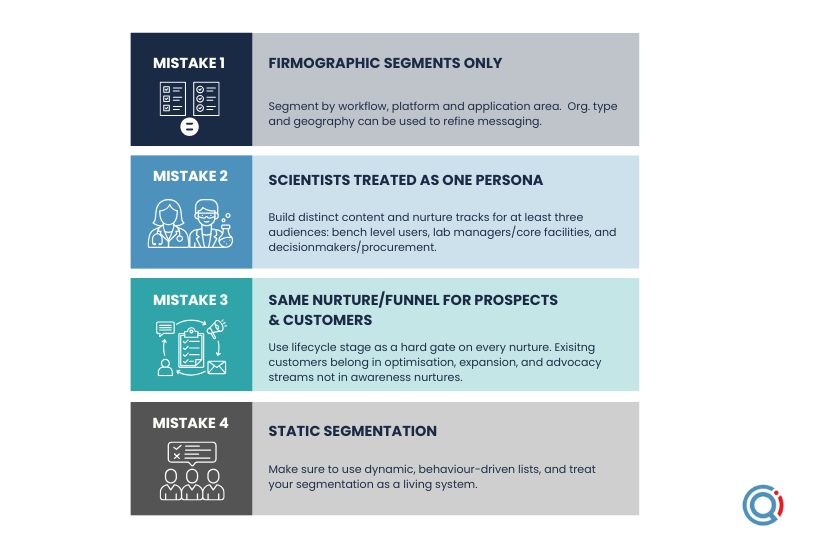
In many cases the root problem is segmentation, and the segments that underperform are often ‘dirty’ or meaningless. For example, segments such as “academic vs industry”, “biotech vs pharma”, or even programme level groupings like “oncology” or “cell and gene therapy” are still too broad to reflect how scientists evaluate tools and commit to new suppliers.
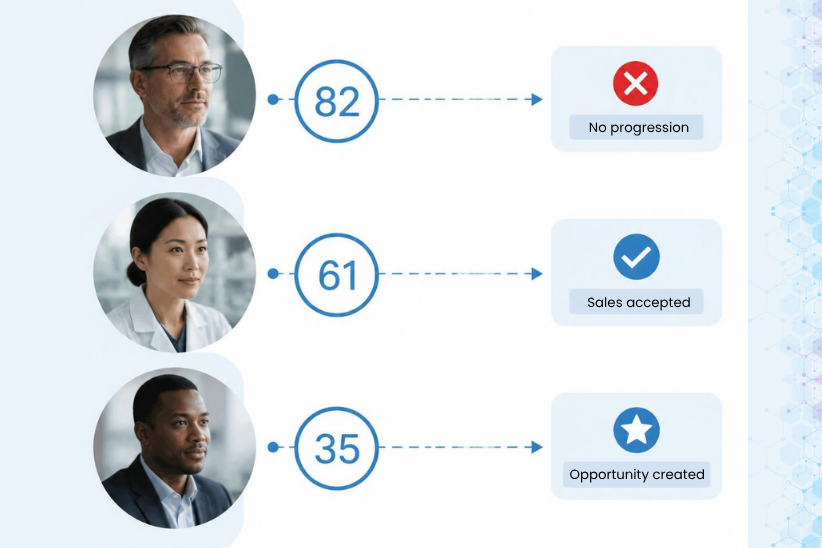
When your database is not segmented by application, workflow, buying context, and behavioural signals such as recency or frequency of engagement, nurture programmes default to a generic approach. They attempt to speak to everyone and end up resonating with no one.
A Bain and AMI study [1] of over 500 enterprise B2B buyers found that 40–60% of deals stall because marketers target the wrong people with generic messages. In technical sectors like Life Sciences, where purchasing decisions are tied to specific experimental workflows, the risk of irrelevant messaging is even greater.
Why does producing more content fail to fix poor Life Science lead nurturing?
In many organisations the instinct is to produce more content, but if segmentation is weak, then it ends up being distributed to the wrong audiences. The net result is expensive new content produced with little visible ROI (Return On Investment) and impact which leads to the wrong conclusions about the effectiveness of marketing. The best place to start is with conducting a review of your segmentation by creating a new blueprint that turns a messy CRM (Customer Relationship Management) into a structured pipeline. Your aim is to be able to clearly answer: who is worth nurturing, with what angle, and toward which commercial outcome.
This article introduces a segmentation model designed for Life Science and Biotech marketing teams.
The three layer CRM segmentation model for Life Science and Biotech marketing
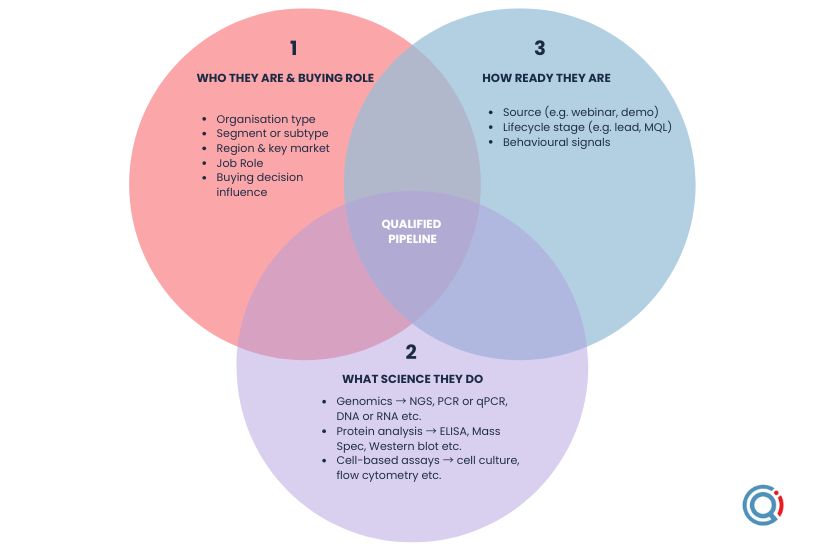
Many marketing teams segment on a narrow number of dimensions such as organisation, job role and buyer type (e.g. economic or technical buyer). This approach is limited. In Life Sciences and Biotech, meaningful useable segmentation that delivers commercial gains requires three intersecting layers.
To understand how to nurture a scientific audience, you need to know:
- Who they are and their role in the buying process
- What science they actually do
- How ready they are to evaluate or buy
The most effective nurture programmes emerge at the intersection of these layers.
A bench scientist running Western blots in an academic lab at low intent needs very different engagement compared to a lab manager evaluating an automated NGS instrument with a budget already approved.
What firmographic data should a Life Science CRM capture?
Most science marketing databases already contain basic firmographic information. At a minimum, the following fields should be standardised.
Organisation type
Use a controlled list such as:
- Academic research institute
- Biotechnology company pre-clinical
- Biotechnology company clinical stage
- Pharmaceutical company
- CRO (Contract Research Organisation) or CMO (Contract Manufacturing Organisation)
- Diagnostics company
- Core facility
- Industrial Biotechnology
- OEM (Original Equipment Manufacturer) or partner
Segment or subtype
Examples include cell and gene therapy, immuno -oncology, microbiology, plant science, diagnostics R&D, and bioprocessing.
Region and key market tags
Region alone is often too broad. Combine it with flags for priority markets such as North America, EMEA, APAC or specific countries including the US, Germany, the UK, Japan, and China.
Role category
Free text job titles should be normalised into categories such as:
- Bench scientist
- Postdoctoral researcher
- Lab manager
- Core facility staff
- Principal investigator or group leader
- Procurement
- Quality or regulatory
- R&D leadership
- Executive leadership
Decision influence
Use this field cautiously. A practical approach is to infer likely influence based on role category.
- Bench scientists and postdocs often influence technology selection
- Lab managers and PIs (Principal Investigator) frequently approve technical choices
- Procurement controls purchasing processes
Sales input can refine this information once opportunities develop. This is the foundation that most teams already have, but it is not enough on its own.
How do you segment Life Science leads by scientific workflow and application?
This is where a data-driven marketer can really start to differentiate. In most laboratories, purchasing decisions are tightly linked to specific experimental workflows rather than general research areas. A team running CRISPR (Clustered regularly interspaced short palindromic repeats) screens evaluates tools differently from a group performing imaging-based assays, even if both sit within the same programme.
Define a controlled list of application clusters aligned with your business. For example:
- Genomics: NGS (Next Generation Sequencing) library preparation, PCR (Polymerase Chain Reaction) or qPCR (Quantitative Polymerase Chain Reaction), DNA (Deoxyribonucleic acid) or RNA (Ribonucleic acid) extraction
- Protein analysis: western blot, ELISA (Enzyme-Linked Immunosorbent Assay), immunoprecipitation, mass spectrometry sample preparation
- Cell based assays: cell culture, flow cytometry, high content imaging
- Sample preparation: nucleic acid extraction, protein extraction, sample clean up
Where possible, capture the platform ecosystem researchers already use, for example:
- Existing sequencing platform
- Flow cytometer manufacturer
- Open or closed systems
It’s also a good idea to track constraints that affect purchasing decisions, for example:
- RUO (Research Use Only) or GMP (Good Manufacturing Practices) environments
- Throughput requirements
- Low input samples
- Automation requirements
Without application-level segmentation, marketing programmes effectively treat all scientists as if they perform the same experiments. In reality, their technical priorities and requirements differ significantly.
How do you segment Life Science leads by buying intent and readiness?
The final segmentation layer captures buying readiness. This layer should combine lifecycle definitions with behavioural signals.
Lifecycle stage
Lifecycle stages should be defined jointly with sales. A typical structure includes:
- Lead
- Marketing qualified lead
- Evaluator
- Sales opportunity
- Customer
- Lapsed customer
Source
Understanding how a contact entered the system provides context for their interest level.
Examples include conference scans, webinar registrations, whitepaper downloads, demo requests, SDR (Sales Development Representative) outreach, partner referrals, and distributor leads.
Behavioural signals
Marketing automation platforms can track engagement signals such as:
- Email engagement
- Webinar attendance
- Repeat website visits
- Content downloads
More useful signals are those that indicate evaluation behaviour, for example: visits to product specification pages, viewing comparison guides, downloading application notes and requesting samples, demos, or quotes.
A nurture programme should not treat a contact who registered a one-off whitepaper download the same way as someone who has repeatedly viewed technical documentation in the past month.

How does CRM segmentation translate into Life Science pipeline generation?
This model moves segmentation from broad categories to actionable intersections of role, workflow, and buying stage. This is where effective nurture programmes are built, but it only works if your CRM (Customer Relationship Management system) can support it and your data is structured well enough to apply it consistently.
In part 2, we will dive into practical step-by-step execution. This includes defining a minimum viable CRM (Customer Relationship Management) data model, cleaning your database, and turning segmentation into working nurture programmes.
If your current segmentation does not reflect scientific workflows, roles, and buying stages of your leads, then your nurture programmes will always default to generic messaging.
Key takeaways
- Generic segmentation (academic vs. industry, oncology vs. cell therapy) is too broad for effective nurturing.
- Effective Life Science CRM segmentation needs three layers: identity, workflow, and buying readiness.
- Behavioural signals (e.g. repeated visits to spec pages) are stronger buying indicators than one-off downloads.
See how we apply this segmentation model to build automated nurture sequences that move leads through the pipeline → Explore the Life Science Lead Nurturing System
References
- AMI & Bain / B2B Institute (2024). B2B Marketing Fundamentals Upended: How Hidden Buyers Are Stalling Deals. [https://ami.org.au/knowledge-hub/b2b-marketing-fundamentals-upended-bain-b2b-institute-study-consigns-traditional-lead-gen-kpis-metrics-to-bin-as-hidden-buyers-missed-trillions-lost/]