
Most Life Science companies generate strong scientific interest but struggle to convert it into pipeline movement. The reason might not be lead or content quality, but something else entirely. It could be about what does not happen inside your CRM.
Ask a Life Science marketing leader about how their lead nurturing works, and most will describe a process that looks something like this: a webinar generates registrations, a follow-up email goes out the next day, a case study lands in inboxes a week later, and then a sales development representative picks up the phone to follow up. The sequence feels logical, and often performs well on engagement metrics, but in most cases, it does not move the pipeline.
The reason is not necessarily that the content is poor, the messaging is wrong, or the marketing team is not working hard enough. The reason is that the lead nurturing model itself was not designed for the way Life Science and Biotech buyers actually make decisions.
The problem with treating lead nurturing like a campaign
A marketing campaign has a start date, an end date, and a goal. It delivers a burst of activity, measures the response, and reports on the results. This model works well for B2B markets where buying decisions are made quickly, by one or two people on the customer side who use relatively simple evaluation criteria to purchase. For example, a small printing services firm needs to purchase accounting software.
Life Science and Biotech markets work differently. Our own analysis of pipeline data shows that the average time from first content engagement to closed deal can exceed 800 days. That is more than two years during which a buyer is actively moving towards a decision. These decisions typically involve a number of decision makers from scientific leadership, procurement, finance, and sometimes regulatory or clinical teams. The evaluation criteria are complex, evidence-dependent, and shaped by the need to build internal consensus and de-risk the final decision. That process happens almost entirely out of the marketer’s sight.
When a campaign-style lead nurture sequence is deployed in that scenario, its inadequate structure becomes obvious. The sequence ends before the buying committee has had enough time to fully evaluate their decision. Marketers see no visible pipeline movement, deem the campaign a lacklustre success, and move on to a new initiative. Ultimately, the organisation that initially generated all that interest ends up absent during the months it takes buyers to evaluate, form preferences, and reach conclusions.
Where pipelines lose momentum
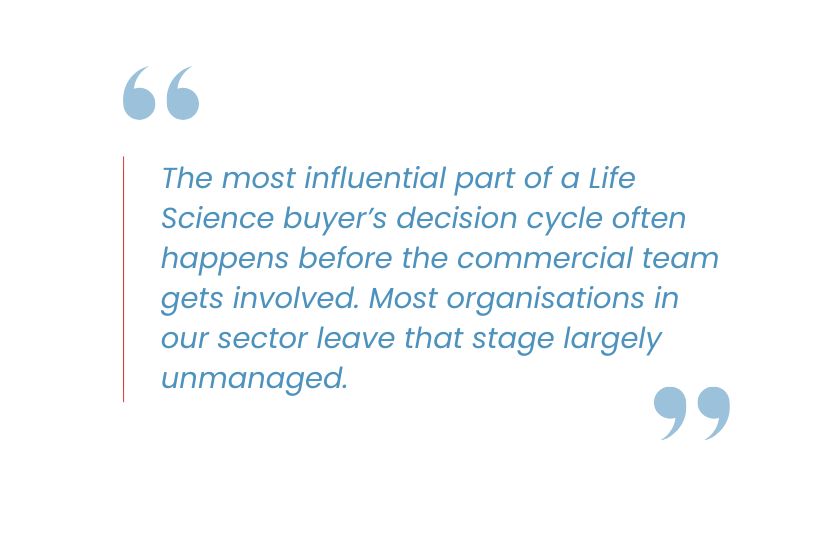
When the Life Science buyer’s journey is mapped visually, this issue is immediately identifiable. Marketing influences the early stage: awareness, interest, and initial engagement. Sales owns the later stage: commercial conversations, proposals, and decisions. But there is a lengthy stage in the middle, often lasting a year or more, during which the buying committee is actively evaluating, building internal consensus, and forming a view of the available options.
During this stage, most Life Science and Biotech organisations are hardly visible. Not because they have stopped caring about the prospect, but because their nurture model was not designed to operate at this pace and depth, or to span multiple stakeholders with slightly varying objectives.
The signals are easy to recognise once you know what to look for:
- Strong engagement from campaigns that do not translate into pipeline movement.
- Sales teams reporting that leads are not ready, even when marketing engagement looks healthy.
- Large numbers of contacts with no recent activity who have not formally disengaged.
- Deals appearing after long periods of silence, with no obvious link to recent commercial or marketing activity.
At first glance, it’s easy to see this as a lead generation or volume issue, which usually means marketers are asked to do more – more campaigns, increased top-of-funnel activity, and generate more net new leads. But the real problem isn’t at the top of the funnel. It’s in the middle, where evaluation happens slowly and where most organisations have no structured presence at all.
At Qincade, we call this the Lead Nurture Gap.
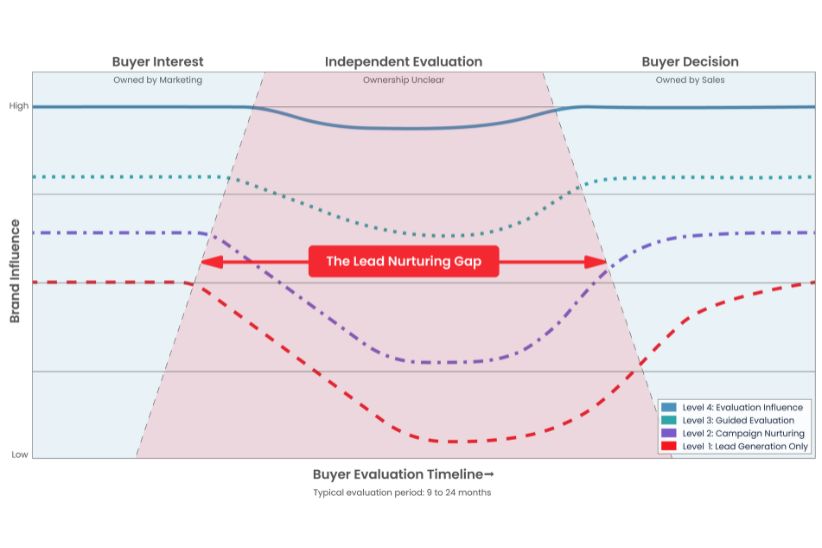
Four levels of buyer progression maturity
Not every Life Science organisation is in the same position; most sit somewhere on a maturity spectrum when it comes to managing buyer progression. Understanding the level at which your organisation sits is the first step toward closing the gap.
| LEVEL 1: Lead generation only | Marketing activity generates interest but influence collapses as soon as a prospect enters the evaluation stage. Pipeline movement depends on the buyer re-engaging of their own accord. |
| LEVEL 2: Camapign-level nurturing | Nurture sequences extend the initial engagement period but are not designed for long evaluation cycles. Influence declines sharply and only recovers if the prospect re-engages. |
| LEVEL 3: Structured lead progression | A deliberate progression process exists. Influence dips during the evaluation stage but remains present throughout the buyer journey. |
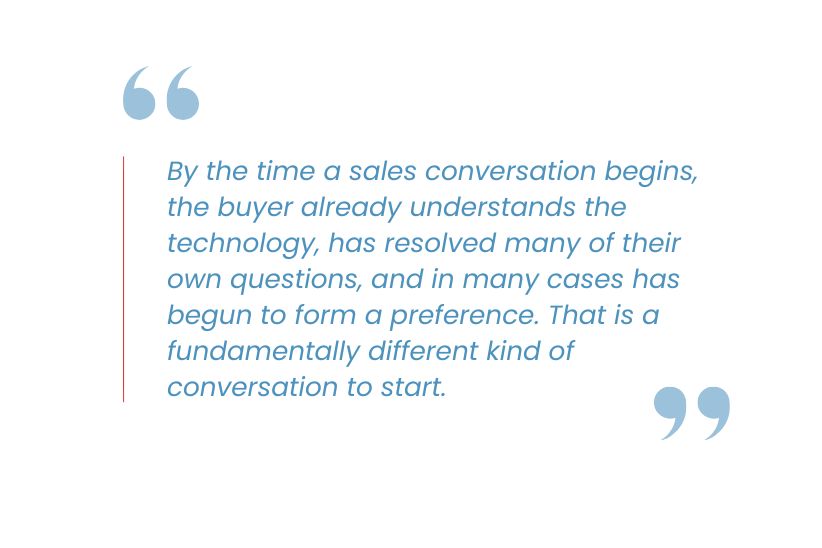
| LEVEL 4: Evaluation-led influence | The organisation actively shapes the buyer’s thinking throughout the evaluation stage. By the time a sales conversation begins, the prospect is already familiar with the technology and has often formed an early preference. |
Most Life Science and Biotech organisations recognise themselves somewhere between Levels 1 and 2. The gap between where they are and where they need to be is not because of a lack of effort or intent. Most of these teams are working hard. The system they operate within was simply not designed for how Life Science buyers actually behave.
Design a system that works for long sales cycles
Treating buyer progression as a strategic asset and systemising it rather than thinking in terms of distinct marketing campaigns helps to build something entirely different that works continuously (not in bursts), delivers content to prospects progressively rather than all at once, and respects buyer behaviour rather than following a fixed schedule regardless of engagement signals.
In practice, this means addressing four things that campaign-style nurturing typically ignores:
- Sequencing content to match where the buyer actually is in their evaluation journey, not where a calendar says they should be.
- Addressing the questions buyers are working through internally: technical comparison, implementation risk, internal justification, peer opinions, stakeholder alignment etc.
- Tracking signals that tell your marketing team when interest is strengthening so that sales conversations begin at the right moment rather than too early or too late.
- Sustaining brand presence across the full evaluation period, which in Life Science and Biotech markets often means maintaining a regular cadence of communication and a coherent narrative over a period of twelve months or longer.
The companies that do this well are not necessarily the ones with the largest marketing teams or the biggest content budgets. They are the ones who understand their buyers’ journey in sufficient detail to design a system around it.
Where to start
The starting point is not a new platform, a larger content team, or a more sophisticated automation setup. Instead, it’s an honest assessment of where your organisation sits in the maturity model, and a clear-eyed view of how your existing contacts experience your brand during the evaluation stage of their decision-making.
A few questions worth sitting with:
- When a prospect engages with your content but is not ready for a sales conversation, what happens next? Is there a defined process to flag them in the system, and follow-up or does it depend on who notices?
- During the 9 to 24 months a Life Science or Biotech buyer might spend evaluating options, how many meaningful touchpoints does your organisation deliver?
- When deals appear after long periods of silence from prospects, do you know what happened in between their first expression of interest and today’s conversation? Or does the evaluation stage remain invisible to you?
If the answers are unclear, the Lead Nurture Gap almost certainly exists inside your pipeline. The encouraging part is that it is not a difficult problem to diagnose, and the organisations that close the gap tend to find that much of the pipeline momentum they needed was already there, waiting to be activated.

Qincade offers a free 30-minute Lead Nurture Readiness Review for Life Science and Biotech companies. In a focused session we work through your current buyer journey, identify where progression breaks down, and outline what structured support would look like in practice.
No obligation. No sales pitch. Just a clearer picture of where you stand.
Answers to the most common questions about the Lead Nurture Gap, lead nurturing in life science, and how to improve B2B pipeline progression.
Frequently Asked Questions
The most reliable signal is what happens after the engagement. If leads regularly go quiet following campaigns, if sales consistently report that contacts are not ready, or if deals appear after long periods of silence with no clear explanation, the Lead Nurture Gap almost certainly exists. Strong engagement metrics and a stalled pipeline are not contradictory; they are the defining pattern of the Lead Nurture Gap.
The gap exists in other B2B markets, but it is more severe in Life Science for two reasons. First, the evaluation period is significantly longer; our own pipeline data shows an average of over 800 days from first content engagement to closed deal. Second, the buying process involves multiple stakeholders across scientific, procurement, and financial functions, each with different criteria and different timelines. Standard nurture models were not designed for this environment.
Not necessarily. Most nurture programmes are designed around campaign logic – a sequence of touchpoints delivered over a few weeks following an initial engagement. This is different from a progression system, which is designed to operate across the full evaluation period and respond to where the buyer actually is in their thinking. The question to ask of any existing programme is whether it is still active and relevant twelve months after first engagement. In most cases, it isn’t.
Marketing automation platforms are excellent at executing sequences, managing lists, and tracking engagement. They do not, on their own, determine what content a buyer needs at a given stage of evaluation, when a progression signal indicates readiness, or how to maintain coherent presence across a multi-stakeholder buying process over an extended period. The platform is the infrastructure. The progression system is the logic that runs on top of it.
It is a focused 30-minute conversation about your current buyer journey. We work through where leads are coming from, what happens to them between the first engagement and a sales conversation, and where progression tends to break down. By the end of the call you will have a clearer picture of where your pipeline is losing momentum and what structured support would look like in practice. Book your call here.
Nothing at all. You do not need to pull reports, gather data, or brief anyone internally beforehand. The conversation is designed to work from your knowledge of your own pipeline and buying process, which you already have. If anything useful emerges that you want to follow up on, we will note it during the call. Book it here.
The call works best with whoever owns the pipeline conversation, typically a Head of Marketing, a Commercial Director, or someone who sits across both marketing activity and sales outcomes. A single person with that view is more valuable than a larger group at this stage.